
November 20, 2026
by Wu Yunzhe
International coverage of the Commercial Aircraft Corporation of China (COMAC) and its overseas ambitions centers largely on a single question: when will the narrowbody C919 secure EASA type validation? Yet while Western validation remains a multi-year process, COMAC and China’s aviation regulator have been assembling a more immediate overseas playbook closer to home since 2022. Using the 90-seat-class C909 regional jet as a commercial wedge in Southeast Asia, paired with cautious near-abroad C919 operations by Chinese airlines, China’s aviation sector is testing tailored placement structures, bilateral regulatory pathways, and front-loaded aftermarket support simultaneously.
By November 2026, commercial flights by C909s and C919s had reached 12 countries outside mainland China, alongside Hong Kong and Macau. Rather than a uniform global push, COMAC’s overseas presence is best understood in three distinct tiers:
Southeast Asia (ASEAN): As China’s largest trading partner for six consecutive years, ASEAN is the only region with foreign airline operations and firm commercial commitments. Across Indonesia, Laos, and Vietnam, local carriers TransNusa, Lao Airlines, and VietJet have deployed nine C909s across more than 20 routes, carrying over 700,000 passengers, while Air Cambodia signed a 20-aircraft C909 purchase agreement in July 2026.
Northern and Western Periphery: Expansion relies on Chinese carriers and derivative showcases. Air China operates daily C909 and C919 flights to Ulaanbaatar, Chengdu Airlines flies C909s from northeastern China and Xinjiang into Russia’s Far East, Tajikistan, and Kyrgyzstan, and COMAC sent a C909 medical aircraft to Central Asia in 2026, staging a static display in Almaty in July and conducting onboard surgeries in Bishkek in September.
Middle East: Presence remains limited to brand visibility. Following earlier demonstration tours in Hong Kong and Southeast Asia, a China Southern C919 flew nonstop from Urumqi to the November 2025 Dubai Airshow alongside a COMAC C919 flying display and a C909 business jet. Yet Gulf carriers continued placing major narrowbody and widebody orders with Airbus and Boeing.
In commercial aviation, demonstration flights and competitive pricing may attract initial interest, but financing structures, regulatory acceptance, and aftermarket reliability determine whether an export program scales. COMAC’s recent record reflects a pragmatic effort to assemble all three, while leaving three structural tests that still lie ahead.
Across ASEAN, COMAC has used different sales and leasing arrangements to match local market conditions and each carrier’s capacity to introduce the C909.
First, lessor-backed network building in Indonesia. With lessor backing, TransNusa, COMAC’s first overseas customer, took delivery of its first C909 in December 2022 and introduced it into service in April 2023. By late 2025, its C909 fleet had grown to five aircraft. On the competitive Jakarta–Kuala Lumpur corridor, TransNusa used the smaller C909 to build frequency to five daily round trips before switching to A321s. The carrier also developed two complementary bases. Its Manado hub links eastern Indonesia’s mining and industrial centers, including Morowali and Weda Bay, with Guangzhou, Shenzhen, and Shanghai. Its Bali hub serves secondary island destinations such as Lombok, Bima, Waingapu, and Wakatobi.
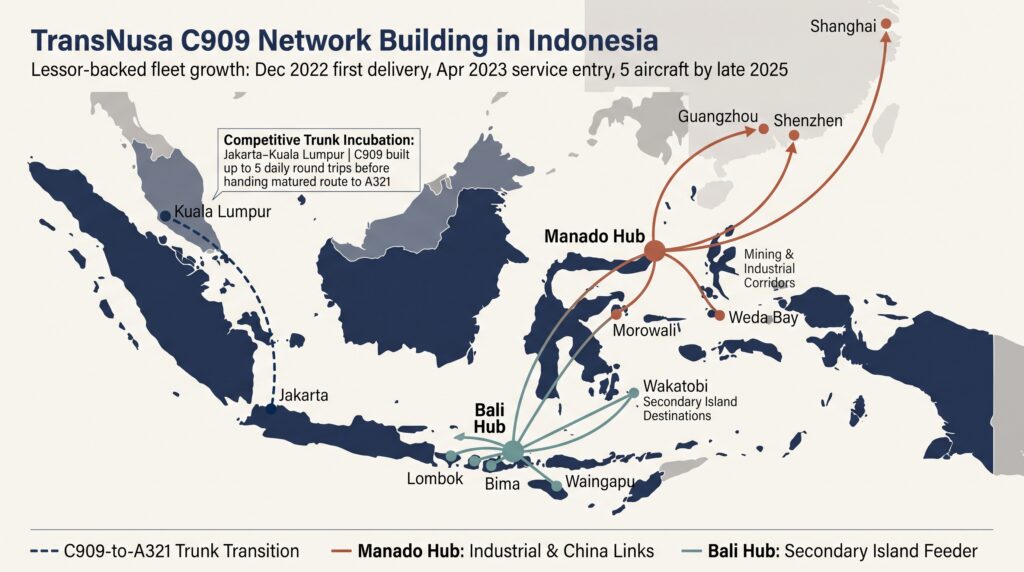
TransNusa’s C909 route network across Indonesia and southern China. Generated by Gemini.
Second, direct dry leasing in Laos. Lao Airlines began C909 commercial service in April 2025 under a direct dry lease. Its two C909s serve high-frequency domestic routes, flying up to eight legs per aircraft per day, as well as regional routes to Bangkok Suvarnabhumi, Kunming, Nanning, and Da Nang.
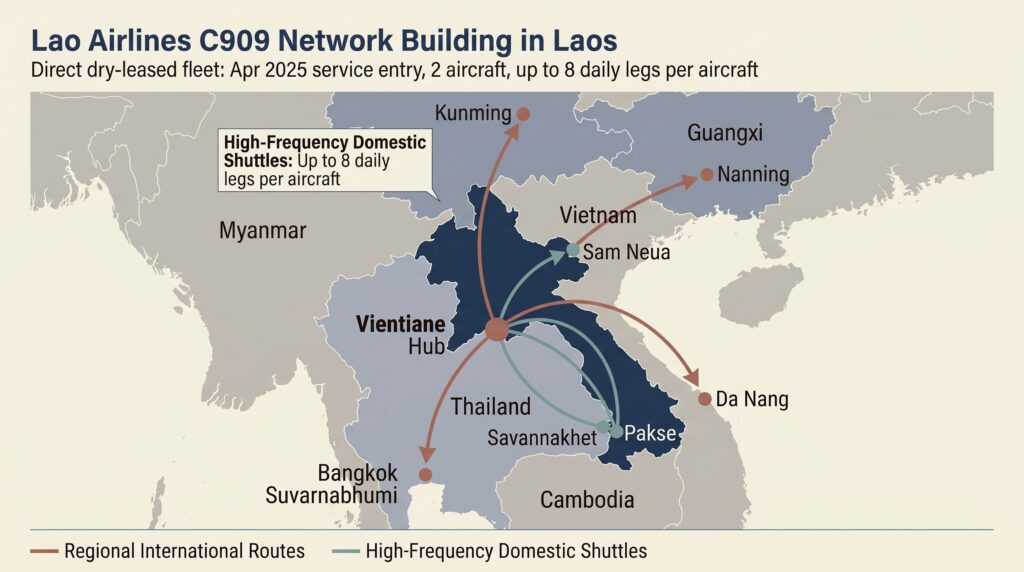
Lao Airlines’ C909 domestic and regional network from Vientiane. Generated by Gemini.
Third, risk-shielded wet leasing in Vietnam. In April 2025, COMAC-backed Chengdu Airlines wet-leased two C909s to VietJet for flights from Hanoi and Ho Chi Minh City to Con Dao, a small island airport with a 1,800-meter runway and limited ground support. Providing aircraft, crews, maintenance, and operational control allowed a major Airbus operator to test short-field and tropical operations without upfront fleet induction or maintenance setup.
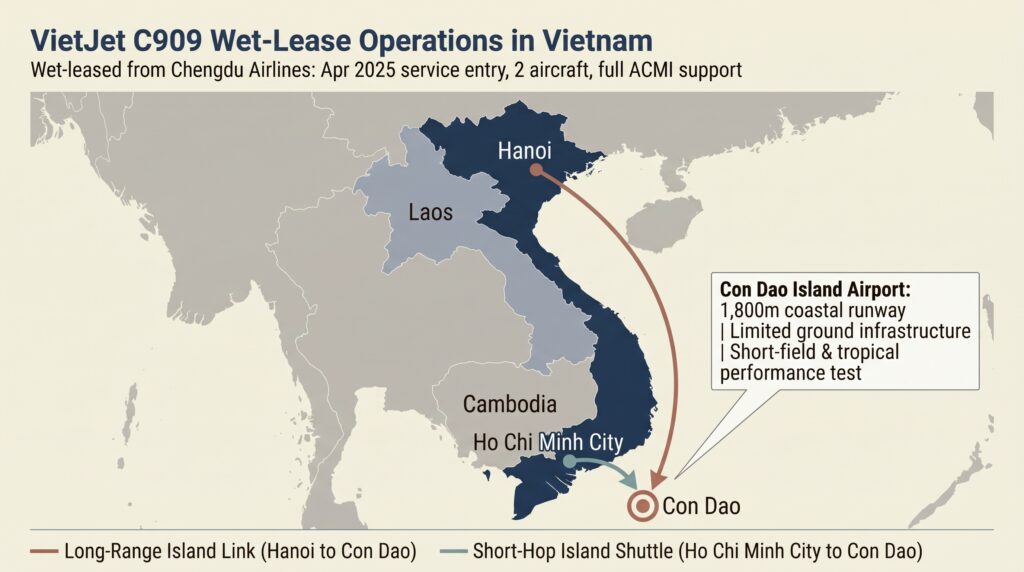
VietJet’s wet-leased C909 routes from Hanoi and Ho Chi Minh City to Con Dao. Generated by Gemini.
Fourth, larger commitments anchored in bilateral cooperation. Following these single-digit fleet trials, Air Cambodia’s July 2026 agreement for 20 C909s, signed alongside a civil aviation cooperation memorandum with Cambodian authorities, marked COMAC’s largest overseas commercial commitment to date.
FAA or EASA validation can give other aviation authorities a widely recognized basis for their own reviews. Without that reference point, the Civil Aviation Administration of China (CAAC) has pursued regulatory acceptance country by country across ASEAN. Indonesia’s approval for TransNusa to operate the C909 included emergency-evacuation demonstrations and 100 hours of proving flights. Laos issued a type acceptance certificate before Lao Airlines began C909 service in April 2025. Brunei separately granted airworthiness acceptance for the C909.
CAAC has also pursued bilateral agreements that can support future approvals. As mentioned in July 2026, China and Cambodia signed a memorandum alongside Air Cambodia’s agreement to purchase 20 C909s. Most recently on November 9, CAAC and the Civil Aviation Authority of Thailand signed a memorandum covering the acceptance of CAAC-approved aviation products in Thailand. Each agreement gives applicants a clearer path in that country, with the national authority retaining the final say.
New commercial aircraft programs rarely stall abroad on aerodynamic performance; they falter when slow spares logistics and unscheduled aircraft-on-ground (AOG) events erode operator confidence, a vulnerability that weighed heavily on Sukhoi’s Superjet 100 exports as well as China’s own earlier overseas rollout of AVIC’s MA-60 turboprop. To avoid repeating those missteps, COMAC has front-loaded OEM field support well ahead of overseas fleet scale.
According to COMAC and Chinese aviation trade reports, COMAC sent field engineers to Indonesia and Laos months before the first C909 deliveries to prepare technical documentation, arrange tooling, and coordinate local regulatory filings. Once the C909 entered service in Indonesia, COMAC engineers worked alongside local maintenance teams during scheduled checks to review work cards and incorporate applicable service bulletins.
In Vietnam, where Con Dao Airport lacks refueling facilities and air-start carts, COMAC’s trade magazine Jetliner reported that the two C909s flying for VietJet achieved 99.92% dispatch reliability and 90.5% on-time performance through mid-October 2025. Chengdu Airlines supplied the flight and maintenance crews under the wet lease, and COMAC provided on-site engineering support.
Chinese airlines are also gaining experience supporting the C919 outside mainland China. China Eastern and Air China operate scheduled C919 flights to Hong Kong with local line maintenance support. In August 2026, Air China added daily C919 service from Beijing to Ulaanbaatar, where it already operated the C909 from Hohhot. Ulaanbaatar thus became the first overseas station to support both types.
Southeast Asia and near-abroad routes have given COMAC verifiable overseas operating history. Yet three structural challenges will shape how far it can build on that experience.
First, the C919 faces a different competitive test. So far, foreign airlines have introduced only the C909. Powered by GE’s mature CF34-10A engine, the roughly 90-seat jet gives carriers the option to serve thinner routes or add frequency on busier ones. Scoot’s use of Embraer’s E190-E2 illustrates the competition in that segment. The C919 will enter a market dominated by the A320neo and 737 MAX. As EASA validation proceeds, prospective airline customers will weigh its operating costs and dispatch reliability against those of both families. International lessors will also need confidence in its residual value.
Second, capital- and policy-assisted entry has yet to be tested against open-market demand. TransNusa benefited from Chinese lessor backing and traffic linked to Chinese-invested industrial parks. VietJet limited its initial exposure through a wet lease from a COMAC-affiliated carrier. Air Cambodia’s purchase agreement is anchored in bilateral aviation cooperation. The next indication of broader demand would be an airline choosing the C909 or C919, through purchase or lease, on the strength of its own route economics and without comparable financing or policy ties.
Third, high-touch OEM support must eventually scale into an independent ecosystem. Embedding experienced OEM engineers on site can sustain strong dispatch metrics for nine aircraft across three neighboring countries. Supporting 30, 50, or 100 aircraft abroad, beginning when Air Cambodia’s 20-jet commitment enters delivery, is a fundamentally different economic proposition. Established OEMs built regional scale through layered third-party networks. Airbus anchors its global support with more than 20 training centers worldwide (largely operated with CAE), Satair’s 10 global spares distribution hubs, and a worldwide network of Airbus-approved third-party MRO providers. In Southeast Asia specifically, Embraer spent over a decade assembling a Singapore crew training center, a Singapore regional distribution center established in 2010, an Asia-Pacific E-Jet E2 full-flight simulator with CAE, and an authorized E2 service center at SIA Engineering Philippines in 2024. While the C909 and C919 can lean on GE Aerospace and CFM International’s expanding regional propulsion MRO networks, COMAC has yet to prove it can transition its airframe support from intensive OEM hand-holding to a commercially sustainable third-party ecosystem.
Comments and corrections are welcome. Please feel free to contact the author at wu.yunzhe@tianlux.com.
Receive primary-source news and evidence-based analysis on China’s aerospace sector in your inbox. Includes free access to regular coverage, alongside previews of member-only articles and newsletters.
Gain full access to all analysis and newsletters, grounded in institutional familiarity, direct information channels, and long-term engagement in China. Available via annual membership.