

Sep 1, 2026
by Wu Yunzhe
10 MIN READ
Over the past decade, the global single-aisle aircraft market has consistently trended toward larger aircraft. The 737-7 and A319neo have attracted limited orders, while Chinese airlines have increasingly concentrated their mainline fleets around the A320, 737 and C919 size category. Embraer, however, is making a different argument: China’s large number of low-frequency and low-to-medium-density routes may create renewed demand for aircraft in the 100- to 150-seat segment.
From a product-positioning perspective, the E195-E2 does indeed sit between the C909 and C919. But with the C909 approaching 100 seats in high-density configuration, the C919-600 extending the family downward to around 140 seats, and other competing options such as the 737-7 and A220-300, the E2 still needs to demonstrate whether China has a 120- to 140-seat market that is large enough, and sustainable enough over the long term, to support an entirely new fleet type.
Embraer recently completed a study of the prospects for China’s market for aircraft with 100 to 150 seats. It concluded that some of China’s low- and medium-density markets are being overserved with large narrowbody aircraft. Around 65% of China’s flights are concentrated on high-density routes, and large narrowbodies with 150 to 200 seats account for about 85% of the country’s single-aisle fleet. At the same time, demand on many low- and medium-density routes is insufficient to support those aircraft efficiently on each flight. Embraer therefore argues that China needs to reconsider the value of aircraft with 100 to 150 seats.
Embraer’s proposed solution is unsurprising: the E190-E2 and E195-E2, both of which have already received Chinese type certificate validation. It is also worth noting how Embraer positions the E2 in China. The company says the aircraft sits precisely between the C909 and C919 and provides an orderly progression between them.
Any assessment of the E2’s place in China must therefore consider COMAC’s existing C909 and C919 product line-up.
Looking at the baseline versions, the C909 mainly covers the 78-to-90-seat market, while the baseline C919 enters the mainstream single-aisle market above 150 seats. The E195-E2, with 120 to 146 seats, sits directly between them.
COMAC has not entirely left this space untouched. The C919 high-altitude variant, the C919-600, shortens the baseline fuselage and reduces capacity to 140 to 160 seats. It has already secured a launch order for 40 aircraft from Tibet Airlines.
The C919-600 completed its first flight in July 2026. On that basis, the part of the market not currently covered by COMAC lies roughly between the upper end of the C909 and the shortened C919, or about 100 to 140 seats.
Embraer is betting that this gap can become the E2’s opportunity in China. The question is whether that judgment will hold up.
Embraer’s 2025 China market report provides a set of figures. Based on data from Sabre and Cirium, together with Embraer’s own analysis, more than 900 city pairs in China are currently served by larger narrowbody aircraft at an average frequency of less than one flight per day.
Embraer defines these as underserved markets. It argues that using smaller aircraft could allow some of them to support higher frequencies without adding too much capacity at once.
The report also identifies 797 city pairs that currently have no nonstop air service and either no high-speed rail connection or a high-speed rail journey of more than 4.5 hours. Under Embraer’s model, 185 of those markets could already support at least three nonstop flights per week at 2025 demand levels. Together, those 185 markets represent potential annual demand of about 9.04 million passengers.
These figures show that Embraer sees a substantial number of Chinese routes served infrequently by large narrowbodies, as well as many city pairs without nonstop service but with a degree of potential air demand. In such markets, the E2 could offer a different balance between matching capacity to demand and increasing frequency.
The first E190 was delivered to Tianjin Airlines in 2008. Tianjin Airlines, Hebei Airlines, GX Airlines, and Colorful Guizhou Airlines later built E-Jet fleets. Embraer said that 85 E-Jets were operating in China in 2023. A319s and 737-700s have also been part of Chinese airline fleets for many years.
Yet after more than a decade of market selection, Chinese airlines did not expand their core fleets into the 100-to-150-seat segment. Instead, those fleets became increasingly concentrated around the A320 and 737. This was clearly not because the market lacked competitive smaller aircraft. The E190 has been successful globally, while the A319 and 737-700 share extensive resources with their respective mainstream narrowbody families.
One important reason is that an aircraft that fits an individual route does not necessarily fit an airline as a whole. An airline with a large A320 or 737 fleet can share pilots, maintenance personnel, spare parts, training, and other operating resources across that fleet.
A 180-seat aircraft may look wasteful when it carries only 130 passengers on a particular route. But when peak-season or seasonal demand rises to 170 passengers, it can still absorb that traffic. It can also be reassigned at any time to routes that need more capacity.
By contrast, adding an entirely new aircraft type for a few dozen low- and medium-density routes requires the airline to establish the corresponding flight operations, maintenance, spares, training, and operational support systems. The savings achieved by using a smaller aircraft on individual routes must be large enough to offset the complexity created by introducing another fleet type.
China also has two distinctive market factors. The first is slot availability at major airports. At airports in Beijing, Shanghai, Guangzhou, and Shenzhen, the theory that a smaller aircraft can improve returns by adding frequency becomes unrealistic. When an airline has limited slots, a 180-seat aircraft naturally creates more capacity value than a 140-seat aircraft. The second factor is high-speed rail. The large regional jet market in the United States developed in an environment where many small and medium-sized cities lacked a high-speed surface transport alternative. In China, many city pairs 500 to 1,000 kilometers apart also face competition from high-speed rail.
The 100-to-150-seat segment has therefore remained outside the Chinese mainstream because of a combination of fleet commonality, airport slots, high-speed rail competition, and a business model in which airlines historically placed greater emphasis on scale and network expansion.
It is worth noting that China’s commercial aircraft industry has considered this issue before. The original ARJ21 family plan included not only the 78 to 90-seat ARJ21-700, but also a stretched ARJ21-900. Under plans disclosed around 2007, the ARJ21-900 would have seated 98 passengers in a mixed-class layout and 105 in an all-economy layout. Full-scale development was expected to begin in 2008, with first flight in 2010. Its positioning was similar to the logic discussed here: a bridge between a small regional aircraft and a 150-seat mainline jet.
The ARJ21-900 never reached product development as originally planned. The main reason was that development of the baseline ARJ21 took far longer than expected. In 2010, when the ARJ21-900 was supposed to make its first flight, the ARJ21-700 was still four years away from receiving its type certificate. By the time the baseline aircraft entered commercial service in 2016, COMAC had long since committed substantial development resources to the C919 as well. The decision not to proceed with the ARJ21-900 may have reflected a market judgment, but it was also clearly shaped by program delays, engineering resources, and product priorities.
According to the official Aircraft Characteristics for Airport Planning (ACAP) document for the baseline ARJ21-700, passenger configurations include 68 seats in a premium-economy layout, 78 in a mixed-class layout, and 90 in an all-economy layout. Marketing material has also shown high-density economy layouts with 95 or 97 seats. COMAC therefore offered configurations extending both downward and upward on this platform, but did not take it beyond 100 seats.
More recent efforts to develop the C909 family have also focused mainly on freighter, business jet, medical, and firefighting variants, rather than a larger stretched passenger model. At the other end, the C919 is extending downward to 140 to 160 seats through a shortened fuselage. The resulting COMAC product lineup is interesting. The C909 broadly covers the market below 100 seats, while the C919 family extends downward from above 150 seats to around 140. The segment between roughly 100 and 140 seats still has no dedicated passenger product.
On August 3 this year, the FAA certificated the 737-7. The smallest member of the 737 MAX family can accommodate 153 passengers in a mixed-class layout or 172 in a single-class cabin, according to Boeing’s ACAP reference layouts. Boeing positions the aircraft for 135 to 160 passengers in a two-class configuration. Embraer’s published material shows typical E195-E2 layouts of 120 seats in three classes, 132 in a single class, and up to 146 in a high-density configuration. The core capacities of the two aircraft differ, but there is clear overlap between the upper end of the E195-E2 and the lower end of the 737-7.
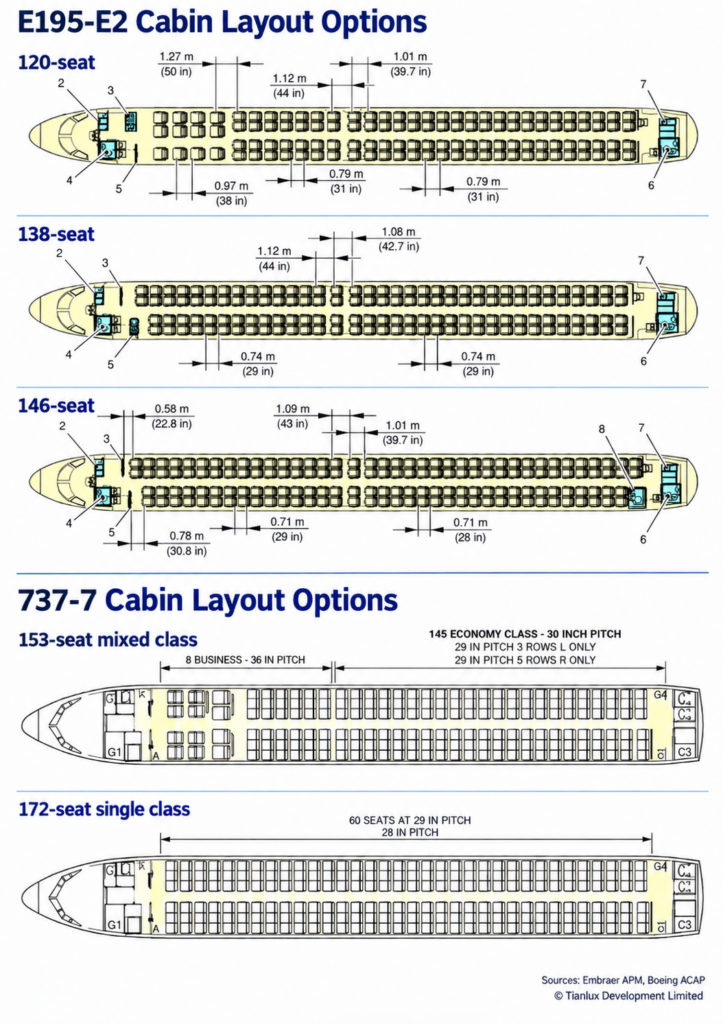
The 737-7 has not attracted many orders globally and is clearly not the most successful member of the 737 MAX family. But for an airline that already operates the 737 MAX, it offers one advantage the E195-E2 cannot replicate: family commonality.
Once the 737-7 receives Chinese type certificate validation, Embraer will face a more complicated competitive landscape in China.
An airline that already operates the 737-8 may find that some routes do not require 160 to 180 seats. Once the 737-7 is validated in China, that airline will have another option besides the E2. The 737-7 would also allow it to share pilots, maintenance systems, spare parts, and operating resources with its existing fleet.
Once the 737-7 enters the competitive field in China, Embraer will have to do more than demonstrate the E2’s operating economics on certain routes to airlines that have 737s but no E-Jets. It will also have to show that, even after adding a new E2 fleet type, the E2’s total cost of ownership remains lower than the cost of introducing the 737-7 into an existing 737 fleet.
That is clearly a higher hurdle.
The 737-7’s market performance also shows that commonality is not a complete answer. If airlines truly had strong demand for aircraft in the 135 to 160-seat range, the 737-7 and A319neo would have far more orders than they do today.
For China, the 737-7 is not the only alternative. The C919 high-altitude variant, the C919-600, lowers the bottom of the C919 family to 140 to 160 seats and has entered flight testing. For Chinese airlines that build substantial C919 fleets in the future, it offers the same possibility of moving down-market through family commonality.
If a route genuinely requires around 145 to 155 seats, the E195-E2 will therefore have to prove itself not only against the larger A320 and 737-8, but potentially against the 737-7 and C919-600 as well.
The E195-E2’s differentiation becomes much clearer when demand is genuinely concentrated around 120 to 135 seats, because it was optimized for a smaller capacity from the preliminary design stage.
The A220 is another important part of this competitive picture. The A220-300 has 140 seats in its standard all-economy configuration, almost the same as the E195-E2’s 132 seats, and both use Pratt & Whitney geared turbofan (GTF) engines. If the A220 enters the Chinese market, it will undoubtedly compete directly with the E195-E2. We nevertheless believe that, in the near term, the A220’s prospects in China are weaker than those of the E195-E2.
The first reason is economics. The A220 and E2 reflect different design priorities. The A220 places more emphasis on range capability, while the E2 focuses more heavily on low operating costs. The E195-E2’s operating empty weight is about 1,500 kilograms lower than that of the A220-300, and it burns less trip fuel on the same mission. At high load factors, the A220-300’s cost per seat-kilometer can approach that of the E195-E2. On most regional and short-haul routes, however, the E2 already has sufficient range. There are relatively few situations in which the A220’s additional 400 to 500 nautical miles of range would create meaningful value.
The second issue is market access. Although more than 500 A220s have been delivered, the prospects for Chinese type certificate validation remain unclear.
The final issue is historical baggage. We believe the A220 carries a heavier burden in China because Canada declined to approve the program’s sale to China in 2017, after which the program turned to Airbus. Christian Kley, Airbus’s own head of single-aisle market development, has also said that this history may be one reason the A220 has yet to win an order in China. In a sense, Airbus is now drawing on the market credibility it has built in China to reopen a door closed by a 2017 decision that Airbus itself did not make.
Tianjin Airlines is the most likely launch customer for the E2 in China.
The reason, once again, is fleet commonality. More than half of Tianjin Airlines’ active fleet consists of Embraer E-Jets, including 32 E190s and 12 E195s. They operate mainly in frontier regions such as Xinjiang and Inner Mongolia, and on routes connecting the airline’s bases with regional markets.
Tianjin Airlines has also formally selected the E2 before. During high-level visits between China and Brazil in 2014, Tianjin Airlines and Embraer announced an agreement for 40 aircraft, including 20 E2s, with E2 deliveries originally planned to begin in 2018. Those aircraft ultimately did not enter the Tianjin Airlines fleet as planned.
Why, then, has an airline with more than a decade of E-Jet operating experience, a mature support system, a network heavily focused on regional markets, and a plan to introduce the E2 more than ten years ago still not followed through?
One factor that cannot be ignored is the timing of the E2’s Chinese type certificate validation. The E190-E2 and E195-E2 received certification from Brazil’s National Civil Aviation Agency (ANAC), the FAA, and the European Union Aviation Safety Agency (EASA) in March 2018 and April 2019 respectively. They did not receive Civil Aviation Administration of China (CAAC) validation until November 2022 and August 2023. The gaps were four years and eight months for the E190-E2 and four years and four months for the E195-E2.
The E190-E2 and E195-E2 have now completed Chinese validation, and the E2 has accumulated several years of commercial operating experience internationally. Tianjin Airlines’ first-generation E-Jets are also gradually reaching the age at which fleet replacement becomes relevant. At the same time, Chinese airlines face much greater pressure on profitability than they did during the rapid expansion years, and the revenue-management value of smaller aircraft may now matter more than it did a decade ago.
The obstacles facing the E2 are equally clear. Tianjin Airlines now also operates an A320 fleet. It is no longer a regional airline that relies primarily on E-Jets to build its network. The restructured HNA group has also shown no overall move away from large narrowbodies. In July 2026, Hainan Airlines Holding signed a purchase agreement with Airbus for 40 A320neo-family aircraft. At a minimum, this shows that large narrowbodies remain an important part of the restructured HNA group’s fleet development.
Tianjin Airlines is therefore both the E2’s most likely point of entry and the best test of Embraer’s market thesis in China. If even this airline ultimately prefers to expand its A320 system rather than replace aging E190s with E2s, Embraer’s case for an underserved Chinese market in the 100-to-150-seat segment will be substantially weakened.
If Tianjin Airlines chooses the E2 and demonstrates in actual operations that a new-generation small narrowbody can improve route economics, the case will be a milestone for Embraer. Its significance for other Chinese airlines may far exceed that of any Embraer market report.
Embraer’s product messaging in China has changed subtly but noticeably over the past several years.
It initially emphasized regional aviation and connections between small and medium-sized cities. When the E195-E2 received Chinese type certificate validation in 2023, Embraer began to stress explicitly that the E2 could fill the capacity gap between the C909 and C919. In 2025, it brought ideas such as moving beyond destructive competition, developing blue-ocean markets, and restoring airlines’ pricing power to the forefront. It now goes further, presenting itself as a builder of China’s aviation ecosystem and emphasizing that the E2 forms an orderly progression with the C909 and C919.
These shifts reflect a change in the questions Embraer must answer in China. In the past, it had to explain why the E2 suited the Chinese market. Today it must also explain how, as the C909 and C919 move into large-scale development, a foreign aircraft can still find a place within China’s commercial aircraft product landscape.
From an airline economics perspective, Embraer needs to demonstrate how many of the more than 900 routes served infrequently by large narrowbodies can sustain aircraft with 120 to 140 seats over the long term; whether higher frequency would increase average fares and total revenue; how large an E2 fleet must become to spread the added costs of maintenance, spares, training, and management; and whether, after fleet commonality is considered, the E2 retains an advantage over the 737-7 and C919-600.
Based on the available information, we believe there is a genuine product gap between the C909 and C919 in China. There is also a substantial number of low-frequency and low- to medium-density routes worth developing further. The evidence is not yet sufficient, however, to show that this demand can form a mature market capable of supporting a large E2 fleet over the long term.
For the E195-E2, this is both the opportunity and the risk in China. At the upper end, the 737-7 and C919-600 can use family commonality to enter the market around 140 seats. At the lower end, high-density C909 layouts already approach 100 seats. Airbus has also long offered a similar down-market option. The A319neo retains a high degree of commonality with the A320neo, yet like the 737-7 it has attracted few orders. This shows, on one hand, that introducing the E2 is not the only option if Chinese airlines genuinely need an aircraft around 140 seats. On the other hand, it also suggests that demand for this capacity may not be strong enough even when pilots, maintenance, and operational support systems can be shared. If most Chinese demand ultimately falls below 100 seats or above 140, the E2’s addressable space will remain limited. The E195-E2’s advantages as an aircraft optimized from the basic design stage for a smaller capacity will become clear only if a meaningful number of routes remain over the long term in a range where large narrowbodies are too large and 90-seat aircraft are too small.
We therefore believe that the E2 is still in a market-validation phase in China. Embraer has identified demand worth testing, and Tianjin Airlines may be an appropriate point of entry. But whether this product gap can become a real Chinese market for the E2 will ultimately depend on whether Chinese airlines can demonstrate, through actual operations and economic analysis, that the E2 creates enough incremental revenue to justify adding an entirely new aircraft type to their existing fleets.
Comments, corrections and professional discussion are welcome. If you have thoughts on the issues raised in this article, please feel free to contact the author at wu.yunzhe@tianlux.com.
