
November 17, 2026
by Wu Yunzhe
On Saturday, November 14, 2026, China’s state-owned Commercial Aircraft Corporation of China (COMAC) completed the maiden crewed flight of its 10-metric-ton-class all-electric commercial aircraft, the CE-25A, at Binzhou Dagao Airport (CBZ/BZDA) in Shandong Province.
According to COMAC, the aircraft carried two pilots and a flight-test engineer, flew for 16 minutes and 38 seconds, and covered 60.4 kilometers. This followed its first uncrewed autonomous flight on February 2 and 19 uncrewed test flights.
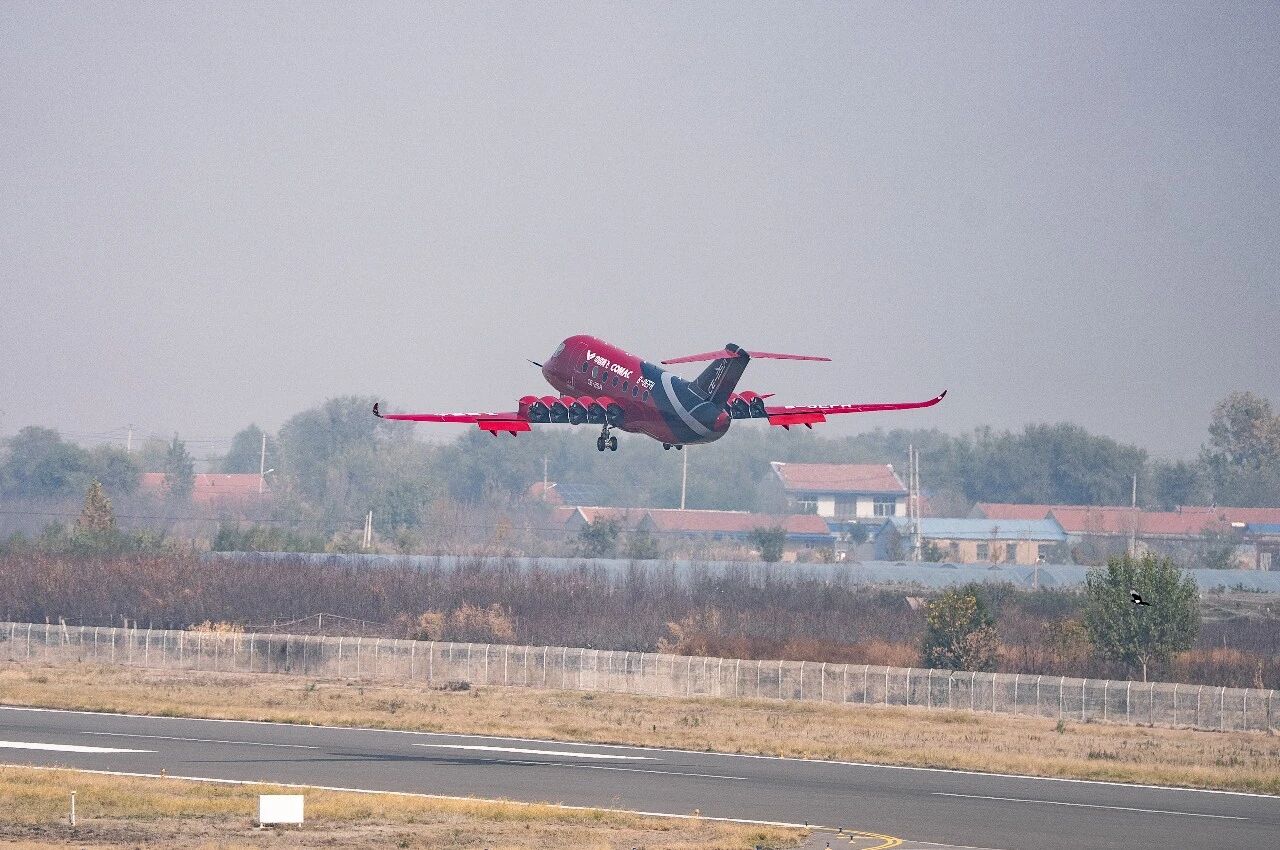
COMAC’s CE-25A all-electric commuter aircraft lifts off during its maiden crewed flight at Binzhou Dagao Airport. Photo: COMAC
Designed for intercity operations with an over-wing distributed electric ducted-fan propulsion system, the CE-25A carries 19 passengers at a cruising speed of 300 km/h, a cruising altitude of 2,400 meters, and a 400-kilometer range.
More notably, its 10-ton maximum takeoff weight (MTOW) pushes a 19-seat commuter design straight into China’s CCAR-25 transport-category airworthiness rules, for which the Civil Aviation Administration of China (CAAC) has already accepted COMAC’s Type Certificate application.
The CE-25A is being developed by COMAC Times (Shanghai) Aviation Co., Ltd. (COMAC Times), a joint venture established in July 2023 and co-owned by COMAC, Contemporary Amperex Technology Co., Limited (CATL), and a company affiliated with Shanghai Jiao Tong University.
CATL is the world’s largest EV battery manufacturer. According to SNE Research, CATL captured a 39.2% global market share in electric vehicle (EV) battery usage in 2025, ranking first worldwide for the ninth consecutive year.
In 2023, CATL unveiled its condensed matter battery technology, reporting a cell-level energy density of up to 500 Wh/kg. The company also disclosed that it was participating in the joint development of a civil electric passenger aircraft.
Yet there is currently no publicly available information confirming which CATL battery model is installed on the CE-25A.
First, the 2,400-meter cruise altitude.
China’s CCAR-25 §25.841, the FAA’s 14 CFR §25.841, and EASA CS-25.841 establish broadly similar requirements for pressurized cabins. Under normal operating conditions, cabin pressure altitude must not exceed 8,000 feet (2,438 meters) at the aircraft’s maximum operating altitude.
The CE-25A’s published cruise altitude of 2,400 meters, approximately 7,874 feet, is close to this threshold. If its maximum operating altitude is similarly limited, an unpressurized cabin could be a viable design choice.
Eliminating cabin pressurization would reduce structural weight and system complexity, an especially valuable advantage for a weight-sensitive electric aircraft.
COMAC has not disclosed whether the CE-25A uses an unpressurized cabin or its maximum operating altitude.
Second, the 19-seat configuration.
A 19-passenger configuration naturally brings to mind normal-category airworthiness rules such as CCAR-23. Across CAAC, the FAA, and EASA, regulatory frameworks are largely aligned on this boundary: aircraft with no more than 19 passenger seats and a maximum certificated takeoff weight not exceeding 8,618 kg (19,000 lbs) can be certificated under Part 23 standards.
However, the CE-25A’s published MTOW of 10,000 kg exceeds the Part 23 weight ceiling by roughly 16%. Consequently, the aircraft must undergo certification under Part 25, aligning with COMAC’s statement that the CE-25A “will follow CCAR-25 transport-category regulations and meet the same safety standards as large commercial airliners.”
This represents a strategic choice: the alternative trade-off would have been to reduce seating capacity to bring MTOW below 19,000 lbs, which would have substantially lowered the certification threshold.
Third, the combination of a 300 km/h cruise speed and a 400 km range.
China’s extensive high-speed rail (HSR) network routinely operates at 250–350 km/h. On speed alone, the CE-25A holds no clear advantage: at a 300 km/h cruising speed, a 400 km flight still requires roughly 80 minutes of cruise time in theory.
The CE-25A is therefore unlikely to compete effectively on busy corridors already served by mature HSR networks. More promising applications may lie in short-haul point-to-point routes across areas with limited rail coverage, challenging terrain, or circuitous overland connections, including mountainous regions, islands, and remote cities. Its 19-seat capacity could also make it suitable for low-density routes that are difficult for larger regional aircraft to serve economically.
Still, hurdles remain: CAAC’s acceptance of the Type Certificate application marks only the start of a complex certification process, particularly for high-voltage aviation battery systems under transport-category safety rules, while the commercial economics of operating a 10-ton aircraft for 19 passengers remain unproven.
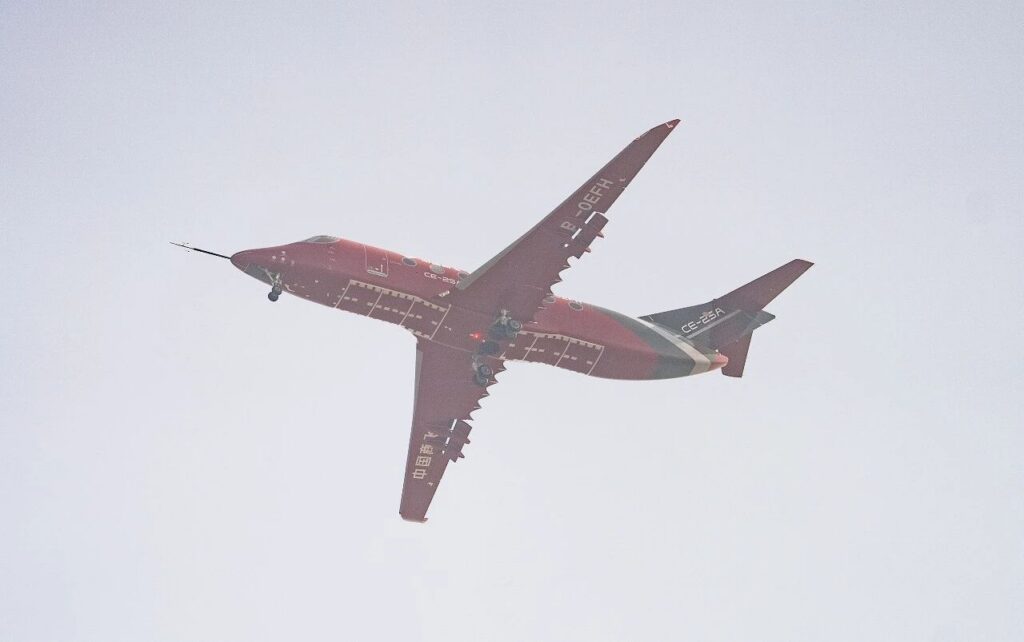
COMAC’s CE-25A prototype, fitted with a nose air-data boom and over-wing propulsors, climbs during its maiden crewed flight. Photo: Comac
The CE-25A is not the only electric fixed-wing aircraft under development globally, but its combination of 19 seats, a 10-ton maximum takeoff weight, and an all-electric propulsion architecture makes it distinctive.
In China, the RX4E, a four-seat electric aircraft developed by the Liaoning General Aviation Academy of Shenyang Aerospace University, received its type certificate from the CAAC in 2025. The aircraft has a maximum takeoff weight of 1,260 kg, a total battery capacity of 70 kWh, and a maximum endurance of 1.5 hours. It provides an example of progress in the certification of small electric aircraft in China.
International programs are pursuing both pure-electric and hybrid-electric architectures, reflecting different approaches to the trade-off between range, payload, and system complexity.
France’s AURA AERO is developing the 19-seat ERA hybrid-electric regional aircraft, powered by eight electric motors and two turbogenerators, with a planned range of roughly 1,500 km and targeted market entry around 2030.
Sweden’s Heart Aerospace has unveiled the ES-36, a 36-seat hybrid-electric regional airliner designed for an all-electric range of around 200 km and a hybrid range of roughly 1,200 km, targeting entry into service in 2031.
In the pure-electric segment, U.S.-based BETA Technologies is pursuing FAA Part 23 certification for its lighter ALIA CX300 utility aircraft, illustrating how pure-electric fixed-wing designs have progressed most rapidly at smaller weights.
U.S.-based Electra is developing the nine-seat EL9, a hybrid-electric aircraft that combines distributed electric propulsion with blown-lift technology to achieve ultra-short takeoff and landing performance.
The industry remains at an early stage. A May 2026 report by the U.S. Government Accountability Office (GAO) noted that, as of March 2026, the FAA had not issued a type certificate for any crewed electric aircraft. Beyond aircraft and propulsion development, commercialization will require appropriate certification frameworks, airport charging infrastructure, and viable operating models.
Why is COMAC pursuing a heavy, commercially risky Part 25 pure-electric path that Western startups have largely avoided? The answer lies in China’s industrial policy priorities.
First, the program reflects Beijing’s policy priorities in green aviation and industrial upgrading.
In 2023, the Ministry of Industry and Information Technology (MIIT), the Ministry of Science and Technology (MOST), the Ministry of Finance (MOF), and the CAAC jointly issued the Green Aviation Manufacturing Development Outline (2023–2035). The document explicitly calls for developing high-energy-density, high-safety aviation batteries and high-reliability electric propulsion systems, as well as research into new-energy commercial aircraft using both pure-electric and hybrid-electric propulsion, progressing from smaller to larger platforms.
Second, the CE-25A may represent an exploration of greater technological self-reliance at COMAC.
Unlike conventional aircraft such as the C919 and C909, the CE-25A uses an all-electric propulsion architecture, eliminating reliance on conventional gas-turbine engines. Its propulsion system could potentially draw on China’s substantial industrial capabilities in batteries, electric motors, and power electronics.
Achieving supply-chain self-reliance is a core strategic goal set by central policymakers, one that depends on state champions like COMAC to translate into industrial reality.
The extent to which these domestic capabilities can meet aviation-grade requirements and achieve technological self-reliance across critical systems remains to be demonstrated.
Third, the joint-venture structure bridges China’s EV supply chain with aerospace.
CATL’s participation in COMAC Times links aviation manufacturing with China’s globally competitive EV battery sector, while Shanghai Jiao Tong University provides early-stage R&D and testing support.
More broadly, the program could create opportunities for Chinese new-energy companies to adapt technologies developed for the EV sector to aviation requirements and expand their participation in the aerospace supply chain.
The CE-25A’s first crewed flight marks an important development milestone, its commercial prospects have yet to be proven. Its ultimate significance will depend on whether China can translate its capabilities in electric propulsion and advanced manufacturing into an aircraft that meets aviation certification requirements and achieves viable operating economics.
Comments, corrections and professional discussion are welcome. If you have thoughts on the issues raised in this article, please feel free to contact the author at wu.yunzhe@tianlux.com.
Receive primary-source news and evidence-based analysis on China’s aerospace sector in your inbox. Includes free access to regular coverage, alongside previews of member-only articles and newsletters.
Gain full access to all analysis and newsletters, grounded in institutional familiarity, direct information channels, and long-term engagement in China. Available via annual membership.