
December 24, 2025
by Wu Yunzhe
WELCOME TO TIANLUX OBSERVATIONS. Read more about our mission. Covering the week of Dec 17-23.
As the industry heads into the Christmas slowdown, China’s aviation system is doing the opposite. This week, Beijing continued tightening the rules while traffic volumes remained elevated, exposing a familiar year-end divergence: demand can recover faster than pricing power, and ambition can run ahead of industrial readiness.
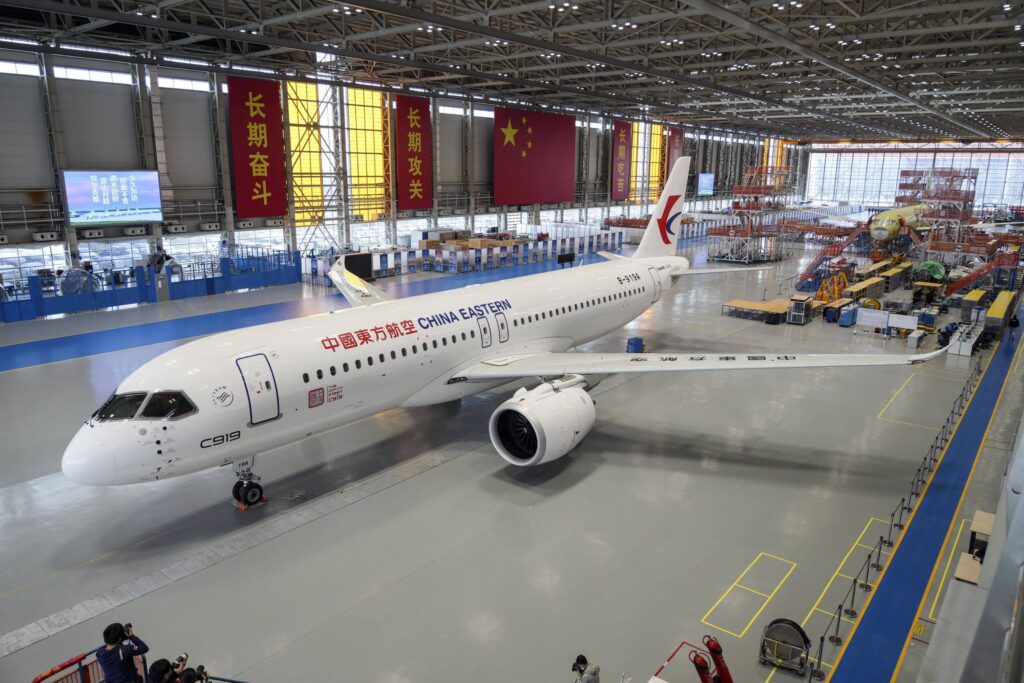
We are diving deep into a two-track re-alignment. In low-altitude, regulators are converting what once looked like pilots and slogans into enforceable governance: law-level authority, mandatory national standards, and a clearer certification lane for powered-lift aircraft. In large commercial aviation, the COMAC C919’s delivery curve is sending a quieter but sharper signal. Scaling is no longer a question of intent. It is a question of repeatability, spares readiness, and training throughput.
As global aviation pauses for the holidays, China is effectively stress-testing its next growth phase in real time. Will a “governability first” approach unlock scale, or lock the market down? Email wu.yunzhe@tianlux.com with tips, pitches, and feedback.
HEADLINE OF THE WEEK: C919: A flat delivery curve is a louder signal than any inaugural flight
The corrected baseline matters: As of December 24, COMAC had delivered 15 C919 aircraft in 2025. One aircraft was delivered on December 23, followed by another on December 24.
The ambition reset is the real signal: At the start of 2025, COMAC publicly communicated plans to deliver around 30 C919 aircraft during the year and scale annual production capacity toward 50 units. In March, internal production ambitions were reportedly lifted further, toward 75 aircraft annually. As the year progressed, those ambitions were revised downward to approximately 25 aircraft.
A shortfall versus that ambition does not automatically imply failure. It implies the ramp has met a binding constraint. In aerospace manufacturing, binding constraints are rarely in final assembly alone. They usually sit upstream in certified parts availability, avionics and engine delivery rhythms, interiors completion, flight-test bottlenecks, or post-production acceptance and induction capacity.
Why the plateau is strategically important: A single-aisle jet is not a “product.” It is a recurring promise. Airlines buy the promise of predictable dispatch, predictable maintenance, and predictable economics over 10 to 20 years. The first phase of any new OEM is about proving the aircraft can fly safely. The second phase is about proving the system can deliver and support fleets, repeatedly, without creating hidden costs for operators.
A 15-unit plateau suggests COMAC is still in that second phase. The constraint is not market demand. China’s domestic market can absorb far more than 15 narrowbodies per year if the product is supportable. The constraint is industrial repeatability. That is an operational concept with four very specific sub-metrics.
Metric 1. Engine and critical systems continuity: If engine deliveries wobble, the whole production cadence wobbles. This is not unique to COMAC. Western OEMs have lived through the same reality in the post-pandemic supply chain. The difference is that COMAC has less slack because it is still building the supplier “muscle memory” required for stable recurring deliveries.
Metric 2. Configuration control: Early fleets often carry multiple small differences across airframes, driven by evolving fixes and incremental improvements. That is normal. What matters is whether configuration drift can be controlled so airlines do not end up maintaining a fleet of “similar but not identical” aircraft that each require different procedures, spares, and training packages.
Metric 3. Support system readiness: Spares fill rates and turnaround times determine whether dispatch reliability improves with fleet size or degrades with it. Dispatch reliability is not a marketing phrase. It is the airline’s daily profit engine. If an operator needs to cannibalize parts, defer fixes, or accept repeated delays, the aircraft becomes a hidden margin eroder.
Metric 4. Human capital throughput: A program scales only as fast as training, simulators, and line maintenance capability can scale. This is why a seemingly small story this week matters. China Eastern received the world’s first C919 simulator designed for airline use and put it into operation.
Simulators are not “nice-to-have.” They are a throughput constraint. Without sufficient simulator hours and instructor capacity, pilot conversion becomes a bottleneck. That bottleneck feeds back into how fast an airline can induct new aircraft, and how fast the OEM can deliver without creating parked assets.
A historical analogy that is useful, not romantic: Airbus in the 1970s faced a credibility gap that was not solved by technology alone. It was solved by building a production and support coalition that could deliver consistently and convince airlines that operational risk was manageable. COMAC is not repeating Airbus’s history. China’s political economy is different. China can compel domestic uptake more easily. But aerospace history still applies in one way. The global market rewards repeatability. It punishes surprises.
The internationalization shortcut is revealing: Laos has confirmed a deal structure under which COMAC would take a 49% stake in Lao Airlines, with the Lao government retaining 51%.
This is an unusual step for an aircraft manufacturer. It signals a strategic logic. When an OEM cannot yet fully rely on “organic” airline confidence in international markets, it can reduce uncertainty by shaping the operating environment: fleet decisions, training cadence, spares planning, and route deployment. Even a minority stake can provide a privileged channel to operational data and a platform to build overseas support routines.
The market implication for airlines inside China: Domestic airlines face a harsh economics reality. When yields are pressured, airlines become more sensitive to disruption costs. A new aircraft type must prove it does not introduce new disruption costs. This is why the C919 ramp cannot be evaluated as a patriotic industrial project. It must be evaluated as a reliability and support project that lives inside an airline P&L.
The market implication for suppliers and investors: The next phase is less about “can COMAC build a narrowbody.” That question is already answered. The next phase is “can COMAC stabilize a multi-tier certified supply chain, grow training infrastructure, and build a support system that improves as the fleet grows.” If the answer is yes, volumes can compound quickly because China has scale. If the answer is mixed, volume will remain deliberately throttled to avoid a fleet-wide reliability backlash.
Tianlux Insight: The C919’s bottleneck is not publicity, nor demand, nor the first few years of safe operations. It is the industrial discipline required for steady-state production under geopolitical friction. Watch two leading indicators in 2026: airline-grade simulator capacity expansion and measurable improvements in spares availability. If those expand while deliveries rise, COMAC is transitioning into a scalable OEM. If deliveries rise without those improvements, the ceiling will shift from “production” to “operator skepticism,” which is harder to reverse.
POLICY & REGULATION: Low-altitude moves from encouragement to enforceable governance
The legal anchor is being strengthened: A third-review draft amendment to China’s Civil Aviation Law was scheduled to be submitted to the national legislature’s standing committee session running from December 22 to 27. The draft adds certification provisions for unmanned aircraft, strengthens passenger rights protection, and improves coordination with air traffic management reform, emergency rescue, and civil aviation policing.
This is the signal that matters. The regulatory environment is being elevated from “department-level rules” to a higher legal level. That increases enforceability and reduces the space for local improvisation.
Passenger rights are being operationalized, not just declared: The draft includes expectations that airlines and airport operators improve capacity planning, optimize resource allocation, strengthen inspections and maintenance to reduce delays caused by internal factors, and provide timely, accurate information to passengers when delays or cancellations occur.
For airlines, this is a cost and discipline story. Passenger rights regimes are effectively operational performance mandates. Over time, they force carriers to invest in IRROPS playbooks, stand-by resources, better maintenance planning, and more transparent comms. The strategic implication is that operational excellence becomes a profit lever again. Carriers that already run tight, resilient operations will absorb this. Carriers that rely on aggressive scheduling without buffers will face higher compliance exposure.
Mandatory standards are the real “market filter”: On December 24, the regulator announced two mandatory national standards for unmanned aircraft focused on operating inspection systems and operating inspection procedures. They take effect May 1, 2026.
The announcement also disclosed scale metrics that explain why Beijing is acting now: more than 2 million registered unmanned aircraft, more than 20,000 operators holding operation certificates, about 26 million annual flight hours, and peak simultaneous operations reaching about 26,000 aircraft airborne at the same time.
Those numbers redefine the risk profile. At this scale, “pilot programs” become insufficient. A weak inspection framework is no longer a local nuisance. It becomes a national safety exposure. So the state is doing what it always does when a sector hits systemic scale. It standardizes the inspection system, standardizes the process, then enforces through licensing and audits.
Powered-lift certification is being standardized: Draft guidance for powered-lift type certification has been issued for comment, with the explicit goal of streamlining airworthiness approvals for eVTOL and similar vehicles. The regulator has also agreed to a type certification basis for Aerofugia’s AE100-200 eVTOL.
This is not just about one company. A type certification basis is a forcing function. It defines what evidence will be accepted. It disciplines the engineering roadmap. It also signals to capital markets which programs are entering the “evidence phase” rather than staying in the “presentation phase.”
What changes for investors and operators: The low-altitude economy is entering a selection phase. Compliance cost will rise. Time-to-certification will become the dominant competitive metric. Many “orders” will be revealed as marketing assets rather than bankable demand, because compliance and operating inspection requirements will force operators to prefer aircraft that can pass audits, not just aircraft that can fly demos.
The state’s intention is not ambiguous: Law amendments, mandatory standards, and certification guidance together form a coherent architecture. The state is not trying to slow the low-altitude economy. It is trying to make it governable. That is the difference between a sector that looks big on slides and a sector that can be insured, financed, and scaled into daily operations.
Tianlux View: The low-altitude economy’s biggest shift is psychological. The winning narrative is changing from “who grows fastest” to “who can prove compliance fastest.” If you are allocating capital, ask one question first: can this platform and its operator ecosystem pass mandatory inspection requirements and progress through a defined certification basis before May 1, 2026. If the answer is vague, the order book is noise.
INDUSTRY & OEM: Volume is rising. Pricing power is not. This is the China airline divergence
Capacity data shows a domestic-heavy system: Industry schedules analysis for December 2025 indicates that domestic capacity accounts for about 82% of total seats to, from, and within China, with roughly 68.7 million domestic seats. Overall capacity is up about 7% year over year, with domestic up about 7% and international up about 8%.
The implication is not “international is recovering.” The implication is “the system’s cashflow engine is still overwhelmingly domestic.” That matters for aircraft programs, airline profitability, and airport economics.
Unit revenue pressure is visible in pricing metrics: Early December monitoring data showed 96,000 passenger flights in a week and 13.555 million passengers carried. The average domestic airfare was RMB 716.4 (US$ 102), down 4% year over year. Domestic RASK was RMB 0.411 (US$ 0.06), down 3% year over year.
These numbers matter because they define the environment airlines are operating in. Airlines can recover demand and still struggle to recover profit. When average fares and unit revenues decline while volumes rise, carriers are effectively buying load factor at the expense of yield.
Financial disclosures reinforce the story: China Eastern Airlines disclosed an expected first-half 2025 net loss attributable to shareholders of approximately RMB 1.2 to 1.6 billion (US$ 171 to 228 million).
Loss narrowing is not the same as profitability. If price competition remains the main domestic market feature, airline balance sheets will keep absorbing the cost of volume recovery.
Geopolitics is still rewriting schedules: Schedules analysis showed China–Japan capacity in December fell to about 1.71 million seats and 8,901 flights, down from about 2.15 million seats and 11,320 flights filed in early November.
That is not a small adjustment. It is a structural volatility signal. If capacity can drop that materially within weeks, network planning requires geopolitical scenario planning, not just demand forecasting.
Why this matters for OEM strategy: A domestic market with weak pricing power is a tough environment to fund rapid fleet modernization. Yet it is also the environment that will absorb most near-term deliveries of domestically built aircraft. This creates a feedback loop: airlines want lower ownership costs and stable support. The OEM needs scale to reduce unit cost and build support muscle. But airlines under yield pressure are less willing to absorb disruption risk from a new type. The result is an equilibrium that often looks like a controlled ramp: growth, but deliberately throttled to protect operational credibility.
A quiet but important infrastructure signal: The operational support ecosystem is being built in parallel. The deployment of an airline-grade full-flight simulator for C919 is a concrete example of how the system is trying to remove human-capital bottlenecks.
For global readers, this is the right lens. In any new aircraft program, industrial scaling is inseparable from training and maintenance scaling.
Tianlux Insight: China’s airline system is not short of demand. It is short of pricing power and predictability in certain international corridors. That combination will keep forcing airlines to optimize for cost and reliability, not for brand narratives. In 2026, the winning airlines will be those who rebuild yield through stable international markets and cargo-linked economics, while running domestic networks with discipline. The winning OEM strategy will be the one that reduces operator risk, not the one that maximizes headline targets.
LOW-ALTITUDE & eVTOL: Global certification benchmarks vs China’s regulatory sequencing
Two different problems are being solved: At first glance, global eVTOL progress and China’s recent regulatory moves appear disconnected. In reality, they are addressing different bottlenecks at different points of the same commercialization chain.
Globally, leading eVTOL programs have entered what can be described as the evidence accumulation phase. Full-scale prototypes are flying. Certification-conforming aircraft are being built. Hundreds of flight hours are planned to generate the data packages required for type certification. The dominant constraint in this phase is engineering evidence: flight test results, system reliability data, and demonstrated compliance with defined certification bases.
China, by contrast, is deliberately prioritizing a different constraint: governability.
China’s sequencing choice is structural, not accidental: Over the past week, three moves clarified Beijing’s intent. First, amendments to the Civil Aviation Law advanced toward law-level authority, explicitly incorporating unmanned aircraft certification, operating oversight, and passenger protection into the core legal framework. Second, two mandatory national standards for unmanned aircraft operating inspection systems and procedures were formally issued, with a fixed effective date of May 1, 2026. Third, draft guidance for powered-lift aircraft type certification signaled that eVTOL would no longer sit in a regulatory gray zone.
Taken together, these are not incremental adjustments. They represent a top-down sequencing decision. China is choosing to lock in legal authority, inspection discipline, and certification logic before allowing large-scale commercialization.
Why China is not copying the global path: In jurisdictions where aviation regulation evolved gradually over decades, eVTOL programs can afford to push hardware first and formalize operating rules later. China does not have that luxury. The scale of its low-altitude ecosystem is already unprecedented. More than two million unmanned aircraft are registered. Tens of thousands of operators are active. Annual flight hours are measured in the tens of millions. At peak periods, tens of thousands of aircraft can be airborne simultaneously.
At that scale, weak inspection frameworks are not a startup problem. They are a systemic safety risk. Beijing’s response is therefore predictable. Before allowing eVTOL to move from demonstrations to dense commercial operations, the state is hardening the rules that define who can fly, how aircraft are inspected, how operators are audited, and how accountability is enforced.
Global benchmarks highlight what China is deferring, not ignoring: When benchmarked against leading global programs, the contrast is stark. Elsewhere, progress is measured by prototype flight campaigns, conformity declarations, and certification flight hours. In China, progress this week is measured by law amendments, mandatory standards, and inspection architectures.
This does not mean China is behind on technology. It means China is deliberately deferring the hardware race until the regulatory spine is in place. That choice reflects institutional memory. In previous fast-growing sectors, permissive early-stage growth often produced safety incidents, regulatory backlash, and abrupt market resets. The low-altitude economy is being designed to avoid that pattern.
The hidden consequence for startups: This sequencing choice has immediate market implications. Compliance cost will rise. Time-to-certification will lengthen. The sector will move from “order-driven enthusiasm” to audit-driven selection. Many announced orders will prove non-actionable once inspection systems, operator certification, and continuing airworthiness requirements are enforced.
This is not a bug. It is the filter.
Why state-linked players gain an advantage: Regulatory sequencing favors organizations that can absorb compliance friction. That includes entities with patient capital, existing aviation compliance teams, and the ability to integrate manufacturing, operations, and oversight into a single system. Private innovation is not excluded, but it is re-priced. Creativity without certification discipline will not survive the next phase.
The false question to avoid: The wrong question is whether China or global peers will commercialize eVTOL first. That framing misunderstands the divergence. The right question is which system produces certifiable, insurable, and governable operations at scale.
Globally, the risk is technical: will prototypes translate into reliable certified aircraft. In China, the risk is institutional: will regulation become too restrictive or just restrictive enough. This week’s signals suggest Beijing is aiming for the latter.
Tianlux View: China’s low-altitude economy is entering a regulatory selection phase, not a growth phase. Global leaders are proving aircraft. China is proving systems. These paths are not competing. They are converging. When they meet, commercialization will accelerate. Until then, the winners will be those who treat certification, inspection, and operating governance as core product features, not compliance afterthoughts.
ICYMI: SIGNALS IN THE NOISE
Cargo is being pulled into a tighter filing regime: On December 19, the regulator issued new implementation measures for filing matters in civil air cargo transport, effective January 1, 2026. Operators must complete filings within 20 days after a license is issued or updated, and previously approved carriers must re-file within 20 days after the rule takes effect. The text repeatedly stresses authenticity of submissions and assigns day-to-day supervision to regional administrations.
Air cargo growth is being “institutionalized.” This raises compliance costs for new entrants and smaller operators, but it also standardizes expectations for freighters, integrators, and cross-border e-commerce charters. In a market where cargo often carries the margin when passenger yield weakens, filing discipline becomes a hidden competitiveness filter.
Inbound demand is being engineered through border policy, not airline pricing: Around the one-year mark of the 240-hour (10-day) visa-free transit regime, official statistics cited 40.6 million foreign entries over the past 12 months, up 27.2% year over year, with usage of the 240-hour channel up 60.8% versus the prior 72/144-hour structure.
This is a structural tailwind for international aviation, but it is uneven. Hubs that can convert “transit permission” into “multi-city itineraries” win. Secondary ports and cities that were added to the program can capture incremental demand without waiting for a full long-haul recovery. Airlines should treat this as a network design input, not a tourism headline.
Corridor volatility is no longer hypothetical: A consular travel notice on December 23 referenced a two-week window (December 23, 2025 to January 5, 2026) in which 46 China–Japan air routes would suspend all flights.
The risk is not a slow downturn. It is sudden corridor shutoff concentrated in thinner city pairs. For planners, this forces a shift from “optimize for demand” to “optimize for resilience,” with more emphasis on hubs, alliance routings, and markets where policy risk is lower.
More to watch with Tianlux in 2026.

Our Service
We bridge insight, expertise, and trusted networks to help our clients navigate China’s evolving aviation landscape.

We help Chinese aviation enterprises and investors manage international exposure, partnerships, and certification risks through tailored consulting and market insight.

We compile and interpret aviation developments between China and the world, turning fragmented information into structured, fact-based analysis for decision-makers.

We provide discreet, insight-driven advisory based on trusted relationships and a deep understanding of global aviation stakeholders.