January 28, 2026
by Wu Yunzhe
The Threshold of Institutional Efficiency. As the final full working week of January 2026 concludes, the Chinese aviation sector has shifted from the “Great Recovery” narrative to the high-stakes implementation of the 15th Five-Year Plan (2026–2030). The week was defined by a top-down re-assertion of state authority over the industry’s physical and financial gateways. While traffic volumes at the Beijing hubs hit historic thresholds, the underlying story is the state’s demand for “Asset Purity”—purging the legacy of infrastructure rot while hardening the operational spine of the national champions.
WELCOME TO TIANLUX CHINA OBSERVATIONS. Read more about our mission. Covering the week of January 21-27, 2026.
The industry is navigating a dual-track re-alignment. In the hangars of Shanghai, the rollout of the plateau-optimized C919-600 marks a new phase of hardware sovereignty. Simultaneously, the diplomatic corridors between Beijing and Ottawa are reopening, signaled by the return of Air Canada to the mainland. This week, we analyze the 124-million passenger milestone of the Beijing dual-hub system, the strategic recycling of China Southern’s widebody assets, and the “Customs Gap” hindering the Greater Bay Area’s low-altitude ambitions.
The Tactical Question: Can COMAC’s specialized “Mountain Jet” (C919-600) successfully displace Western OEMs in China’s high-margin plateau markets? Email wu.yunzhe@tianlux.com with your take.
HEADLINE OF THE WEEK: The 124 Million Threshold - Decoding The CAH 2026 Work Conference
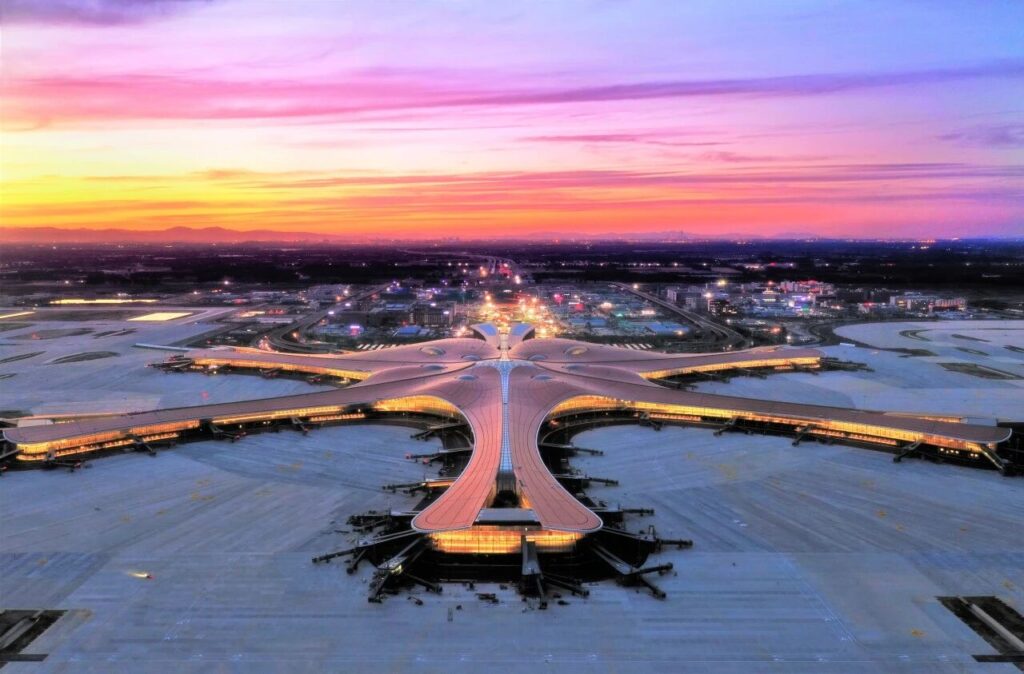
The birdview of Beijing Daxing International Airport (DAX) | Photo courtesy of Capital Airports Holdings Co.,Ltd.
The Event: The CAH Strategic Alignment. On January 21, 2026, Capital Airports Holding (CAH) – the state-owned behemoth managing 53 airports across China, including the primary Beijing hubs – convened its 2026 Work Conference. This summit was more than a post-holiday review: it served as the operational launchpad for the 15th Five-Year Plan.
The Power Signal: Song Zhiyong’s Presence. The attendance of CAAC Administrator Song Zhiyong at the CAH conference is the most significant signal of the week. In the Chinese political economy of aviation, the presence of the industry’s “Final Boss” at a group-level annual meeting is rare. It confirms that the Capital Airports Group is the primary instrument of state policy for the 2026–2030 period. Beijing is signaling that the management of the “National Gateway” is no longer just a corporate task: it is a matter of central state authority.
The Data: The Dual-Hub Reality. The headline figure for 2025 was the combined annual passenger throughput of 124 million at Beijing Capital (PEK) and Beijing Daxing (PKX), representing a 6.5% year-on-year increase.
- The Punctuality Metric: Hub airports under CAH achieved an average departure punctuality rate of 82%, outperforming the industry average by 1.05 percentage points.
- Asset Utilization: Boarding bridge utilization reached 49%, a critical increase of 0.81 percentage points over the previous year.
The Strategic Question: Growth vs. Governance. For global observers, these numbers suggest a system operating at peak technical capacity. However, the conference’s focus was not on further volume expansion but on “building world-class aviation hubs” through “comprehensive and deepened reforms.” This aligns with our previous analysis of the “Profitless Boom”: the state is now pivoting from processing raw volume to maximizing the quality and efficiency of its existing assets.
The “Hub-and-Spoke” Strain. While the Beijing hubs are thriving, the broader CAH network remains under the “Provincial Group Strategy” strain. The profitable high-volume hubs must continue to cross-subsidize money-losing regional nodes across the 53-airport portfolio.
Tianlux View: The CAH 2026 mandate to “resolutely uphold the bottom line of safety” while driving “overall improvement in efficiency” is a signal that the state is reaching the limits of its current cross-subsidy model. In 2026, we expect CAH to push for “Smart Airport” technologies—biometrics, autonomous ground handling, and AI-driven slot management—as the primary tools to extract margin where volume growth has plateaued.
The Verdict: The Efficiency Floor. The 92.82% punctuality rate is no longer an achievement: it is the new Efficiency Floor required to justify the massive fixed-asset investments of the 14th Five-Year Plan. Investors should monitor whether CAH can translate this operational precision into financial “Asset Purity” in its future reporting.
POLICY & REGULATION: Diplomatic Recalibration And The "Open Skies" Dividend
The News: Air Canada’s Return to Shanghai. On January 22, 2026, Air Canada released its latest round of intercontinental route adjustments for the Summer 2026 season. The plan marks a significant “recalibration” of the China-Canada corridor.
- The Vancouver–Beijing Expansion: Starting May 1, 2026, service will increase from four flights weekly to a daily service using Boeing 787-9 aircraft.
- The Toronto–Shanghai Resumption: On June 3, 2026, Air Canada will officially resume its Toronto Pearson (YYZ) to Shanghai Pudong (PVG) route with four flights weekly. This route has been suspended since the onset of the pandemic in 2020.
The Catalyst: The Carney Visit. This capacity surge is a direct commercial dividend of Canadian Prime Minister Mark Carney’s recent four-day visit to China—the first such visit by a Canadian leader since 2017. Carney emphasized the importance of the Chinese outbound market and the need to “recalibrate” bilateral ties through increased exchanges in tourism, museums, and arts.
The Brazil Visa-Free Reciprocity. On January 23, 2026, Brazilian President Lula announced a visa-free policy for Chinese citizens for certain short-term visa categories. This is a reciprocal move following China’s decision to grant visa-free entry to Brazilian citizens in 2025.
- The Strategic Logic: Brazil is positioning itself as the primary gateway for China’s deepening ties with Latin America. By removing friction for business travelers, Brasilia is facilitating the “corporate bridge” for Chinese EV manufacturers (BYD, GWM) and infrastructure firms.
Tianlux Insight: Policy as the Ultimate Flight Director. The rapid capacity response from Air Canada proves that in the Chinese market, commercial demand is secondary to political “chill” or “thaw.” The “Carney Recalibration” has unlocked capacity that was frozen for six years. For airlines, the takeaway is clear: network design in 2026 is increasingly a subset of geopolitical scenario planning.
INDUSTRY & OEM: COMAC’s Ramp Reality And The Plateau-Optimized C919-600
The Data Check: Clarifying the 2026 Target. There has been significant market noise regarding COMAC’s production targets. We must clarify the baseline. In 2025, COMAC delivered a total of 41 aircraft: 25 C909s (ARJ21) and 16 C919s.
- The C919 Ramp: For 2026, the target is to deliver 28+ C919s. While this represents a significant 75% increase in production for the narrowbody program, it is not a “doubling” of total OEM performance.
- The Maturity Signal: At a rate of one aircraft every 10–15 days, COMAC is attempting to stabilize its production line and move toward “industrialized scale.”
The New Variant: C919-600 (The “Mountain Jet”). The industry’s attention this week shifted to the C919-600, the shortened, plateau-optimized variant. The first aircraft has officially rolled off the line featuring a distinct “snow mountain” livery on the fuselage.
- Product Strategy: By shortening the fuselage, COMAC has achieved a higher thrust-to-weight ratio and better climb performance. This is a targeted strike against Western OEMs in the high-plateau markets of Xinjiang, Tibet, and Sichuan.
- The Niche Moat: The C919-600 is not a mass-market play like the -800 series. It is a “Precision Tool” designed to capture high-margin regional routes where air density is thin and operational requirements are extreme.
Asset Management: Southern’s B787-8s Move to Thailand. In a major secondary market shift, Thai Airways is negotiating to lease 10 Boeing 787-8 aircraft previously operated by China Southern Airlines.
- The Deal: The aircraft were previously listed for sale on the Shanghai United Assets and Equity Exchange. Thai Airways is negotiating via the lessor Avolon, which has reportedly agreed to lower the lease prices.
- The Timing: If finalized by mid-February, Thai Airways expects to induct the aircraft between June and July 2026.
Tianlux View: The Yield Optimization Phase. China Southern’s disposal of these widebodies confirms that the “Big Three” are prioritizing Asset Purity over raw fleet size. As they transition to newer models or more supportable indigenous types, they are recycling high-quality metal into the Southeast Asian market. For Thai Airways, this is a low-cost capacity infusion that allows them to rebuild their long-haul network without the high CAPEX of new orders.
LOW-ALTITUDE & eVTOL: The GBA Bureaucracy Barrier
The News: The “Customs Gap” in the Bay Area. On January 26, leaders of the GBA Low Altitude Economy Alliance highlighted a critical bottleneck: the lack of a “One Window” regulatory body for cross-boundary operations between Shenzhen and Hong Kong.
- The Issue: Trials for cross-boundary drone logistics have been delayed by the need to navigate multiple departmental silos (Customs, Immigration, ATC) individually.
- The Solution: Gary Yeung, the alliance’s secretary-general, called for Hong Kong to establish a dedicated bureau to harmonize licensing, insurance, and traffic management (UTM) standards.
Tianlux Insight: From Vision to Paperwork. The GBA is the world’s most advanced low-altitude cluster with 15,000 companies, but it is currently hitting an Institutional Ceiling. The state’s “One Net” mandate is a vision, but the reality is still stuck in legacy customs paperwork. The winners in 2026 will not be those with the best motors, but those who can help the state digitize the “Customs Gap.”
ICYMI: Signals In The Noise
The Airport Purge: Institutional Cleansing. The 15th Five-Year Plan is being preceded by a massive wave of anti-corruption actions in the airport sector.
- Sichuan: Yang Taidong, former GM of Sichuan Airport Group, is under investigation for serious violations.
- Shanghai: Huang Zhenglin has been expelled from the Party for “purchasing goods from relatives at inflated prices,” causing massive losses to state interests.
- Anhui: Zhou Xiqiao, former Chairman of Anhui Airport Group, was announced as under investigation on January 26.
- The Verdict: This is a Systemic Reset. Beijing is clearing the deck of “infrastructure rot” before releasing the massive capital injections planned for the 2026–2030 period.
TAAG Angola Airlines Returns. The African carrier has submitted a schedule to resume Luanda to Guangzhou service starting March 30, 2026.
- The Setup: The route will operate three times weekly using Boeing 787-9s with a high-density Premium Economy (W63) and Economy (Y282) configuration.
- The Insight: This is a “Resilience Corridor” for the Belt and Road Initiative, facilitating the movement of engineers and traders between the Pearl River Delta and the resource-rich Angolan market.
To request a PDF version of this report, please contact wu.yunzhe@tianlux.com.

Our Service
We bridge insight, expertise, and trusted networks to help our clients navigate China’s evolving aviation landscape.

We help Chinese aviation enterprises and investors manage international exposure, partnerships, and certification risks through tailored consulting and market insight.

We compile and interpret aviation developments between China and the world, turning fragmented information into structured, fact-based analysis for decision-makers.

We provide discreet, insight-driven advisory based on trusted relationships and a deep understanding of global aviation stakeholders.