January 21, 2026
by Wu Yunzhe
The Audit of Physical Evidence. As the third full working week of 2026 concludes, the Chinese aviation sector has transitioned from administrative alignment to a high-stakes physical audit. The week was defined by the moment the “Hardware Fortress” met its external judges. While the CAAC projects a record 95 million passenger trips for the 40-day Spring Festival migration: a 5.3% increase year-over-year: the underlying story is no longer the quantity of travel, but the quality and sovereignty of the machines facilitating it.
WELCOME TO TIANLUX OBSERVATIONS. Read more about our mission. Covering the week of January 14-20, 2026.
The industry is bracing for a 2.6 million-passenger daily peak, but the strategic milestones are currently being recorded in the hangars of Shanghai and the test cells of the Aero Engine Corporation of China (AECC). This week, we analyze the official commencement of EASA’s physical verification flights for the COMAC C919, the historic 35.2-ton thrust milestone of the indigenous CJ-2000 engine, and the “synergy phase” of the low-altitude economy as EHang shuffles its leadership for scale. The strategic question for 2026 remains whether China can successfully bridge the “Propulsion Gap” while the CAAC enforces a price floor to end the era of profitless growth.
The Tactical Question for the Propulsion Pioneers: With the theoretical barrier to a “Fully Indigenous” commercial widebody is falling. However, the path from a thrust record to a revenue-generating flight is paved with millions of hours of reliability data. How many more Spring Festival cycles must pass before an indigenous-powered jet earns its first commercial revenue dollar in regular service? Is the 2028 horizon a realistic industrial milestone or a political ambition? Email wu.yunzhe@tianlux.com with your take.
HEADLINE OF THE WEEK: The Audit And The Afterburner: EASA Pilots And The 35-ton Thrust Barrier
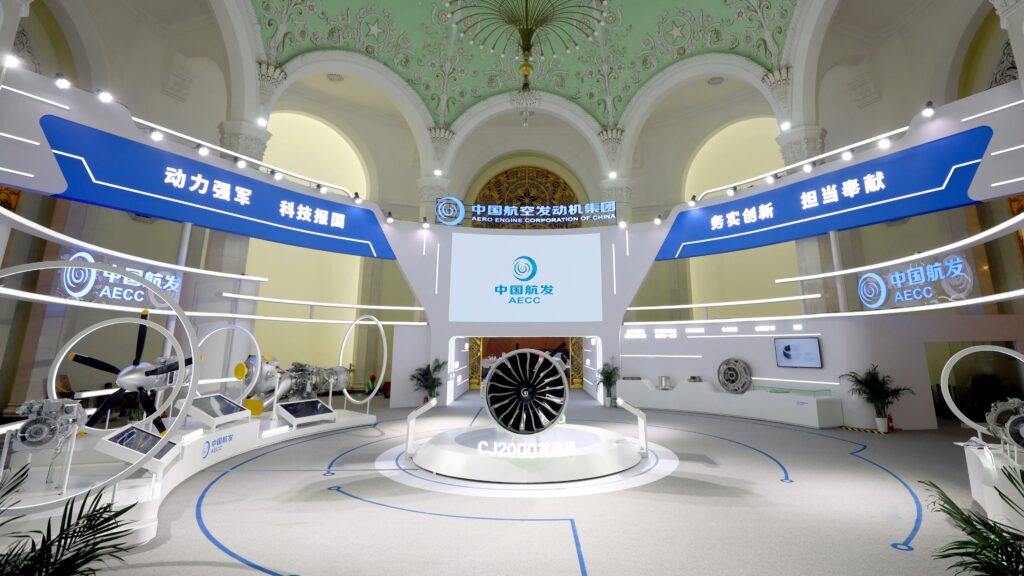
A model of the CJ-2000 engine exhibited by AECC at the 2023 Shanghai Airshow. | Photo courtesy of AECC.
The Event: EASA Pilots Take the Stick. On January 15, 2026, the European Union Aviation Safety Agency (EASA) officially transitioned the COMAC C919 certification process from a bureaucratic exchange to a physical trial. Two EASA test pilots have begun “Validation Sorties” in Shanghai, marking the critical Phase 3 of the certification regime. These flights are not ceremonial. They involve aggressive maneuvering, stalls, and system-failure simulations designed to prove that COMAC’s fly-by-wire logic and handling qualities meet European CS-25 standards.
The Certification Context: The Six-Month Window. EASA engineers are currently scrutinizing three core areas: handling qualities, flight-control laws, and the technical documentation that underpins them. Historically, Western regulators have viewed Chinese data packages with a “trust but verify” lens. By entering the cockpit now, EASA is signaling that COMAC’s data is sufficiently robust to warrant a physical audit. However, the path remains steep: data analysis from these flights will take at least six months.
The Propulsion Breakthrough: CJ-2000 Hits 35.2 Tons. While the C919 seeks European validation for its airframe, the C929 widebody program achieved its most significant milestone to date in the engine test cell. On January 12, the Aero Engine Corporation of China (AECC) confirmed that the CJ-2000 turbofan: designed specifically for the widebody C929: reached a maximum thrust of 35.2 tonnes (70,400 lbf). This puts the engine in the performance class of the GEnx-1B (Boeing 787) and the Rolls-Royce Trent 1000 (Airbus A350).
The Engineering Reality: Thrust vs. Reliability. Reaching 35.2 tons of thrust is a triumph of physics, proving that China has mastered the high-bypass turbofan morphology. The CJ-2000 features a bypass ratio of 12:1, which is the industry standard for modern fuel efficiency. However, the “So What” for commercial operators lies in the “Time on Wing” metric. Western engines like the GEnx have a cumulative reliability history of millions of flight hours. The CJ-2000 is still a “demonstrator.” Reaching a 35-ton record proves the heart is strong, but it does not yet prove the heart is durable enough for the 3,000-hour endurance cycles required for commercial profitability.
The Divergence: Airframe Sovereignty vs. Propulsion Reliance. This week’s events highlight the “Sovereignty Gap.” The C919 is a maturing airframe still powered by the Western CFM LEAP-1C. The CJ-1000A (the C919’s indigenous engine candidate) is currently on the “cusp” of certification but is not expected for Entry Into Service (EIS) until 2027-2028. Consequently, COMAC must continue its “Dual Track” strategy: courting EASA to legitimize its Western-powered jets today, while pouring billions into AECC to ensure it can cut the Western propulsion cord by 2030.
Tianlux View: The Certification Moat. For global lessors and the Boeing/Airbus duopoly, the EASA flights are the metric that matters most. A European Type Certificate (TC) would turn the C919 from a “Chinese curiosity” into a “bankable asset.” However, for China’s long-term strategic planners, the CJ-2000 record is the more critical signal. It proves that the “last frontier” of aviation: widebody propulsion: is no longer a theoretical barrier. We predict the first commercial revenue flight of a Chinese jet with a Chinese engine will not occur before the 2028 Spring Festival.
POLICY & REGULATION: The Architecture Of Chunyun And The "Involution" Floor
The Data: 95 Million Trips. On January 19, the CAAC released the 2026 Spring Festival (Chunyun) projections. The 40-day rush (February 2 to March 13) will handle 95 million passenger trips, a record high. The sector is scheduled to manage an average of 19,400 flights per day: a 5% increase year-over-year.
The Regulatory Pivot: Managing the “Stress Peaks.” The CAAC is anticipating two distinct peaks where daily volume will hit 2.6 million passengers. To prevent a systemic collapse, the regulator is implementing “targeted measures” that go beyond capacity. For the first time, there is a focus on “integrated tourism-aviation development,” where the CAAC is actively coordinating with the Ministry of Culture and Tourism to stagger holiday traffic toward secondary hubs like Harbin and Haikou.
The Economic Floor: Anti-Involution Policy. Behind the 95 million figure is a struggle for yield. In 2025, Chinese airlines operated at record volumes but dangerously thin margins (averaging 8.44 RMB per passenger). This week, the CAAC signaled the deployment of its “Price Monitoring and Early Warning Mechanism.” The regulator is now actively discouraging “irrational price wars” during the peak season. In the “Governed Age,” a flight that is 100% full but generates a loss is viewed as a failure of management, not a success of demand.
Tianlux Insight: The Death of the Ultra-Cheap Fare. The CAAC’s intervention marks the end of the “Golden Age” of deregulated competition. By imposing a “soft floor” on ticket prices for trunk routes, Beijing is essentially cross-subsidizing the high operational costs of its state-owned carriers. For global travel managers, this means the era of “China for pennies” is over. Expect domestic airfares to rise by 8-12% during the 2026 peak as the state forces the market to prioritize balance sheet health over market share.
INDUSTRY & OEM: COMAC’s Scaling Challenge And The C929 Hedge
The Production Milestone: 200 Jets and the 30-Unit Barrier. COMAC entered 2026 having surpassed 200 total deliveries (including C909/ARJ21 and C919). While the ramp-up is accelerating: the second 100 jets took only three years vs. seven for the first 100: the C919’s individual production remains the bottleneck. In 2025, COMAC delivered only 16 C919s, falling short of its 30-unit ambition.
The Case Study: Air China’s 7th C919 (B-658R). This week, Air China is conducting high-frequency “induction testing” on its newest C919 (Registration B-658R). The goal is to prove that the jet can maintain an 8-hour daily utilization rate during the high-stress Chunyun environment. If B-658R and its siblings can maintain 99% dispatch reliability during the 95-million passenger rush, it will provide the “operational data” EASA needs to finalize its audit.
The Industrial Strategy: The 94.1 Billion RMB Hedge. The late-2025 capital injection into COMAC is now being deployed into the “Tier-1 Localization” program. This week, reports from the Ministry of Industry and Information Technology (MIIT) suggest that the C919’s localization rate by value is approaching 65%. However, the remaining 35% comprises the “brain” (avionics) and the “heart” (engines).
Tianlux View: Strategic Patience. COMAC is not a commercial company; it is an industrial mobilization. Investors should not judge it by its 2025 delivery shortfall but by its “Institutional Hardening.” By securing 94.1 billion RMB in state equity, COMAC has bypassed the need for short-term commercial returns. It can afford to wait for the CJ-1000A and CJ-2000to mature while the airframes earn “operational credibility” on domestic routes.
LOW-ALTITUDE & eVTOL: The Synergy Phase And The Tilt-rotor Breakthrough
The News: EHang’s New CTO. On January 16, 2026, EHang Holdings officially appointed Mr. Shuai Feng as Chief Technology Officer. Feng, a founding member of the team with a background in Tsinghua’s automation program, is tasked with moving EHang from “prototype innovation” to “industrial synergy.”
The Strategic Shift: From PPT to Production. EHang has already won the “Certification Race” with its EH216-S. Now, it faces the “Scaling Race.” Feng’s appointment signals a focus on supply chain reliability and manufacturing execution. As EHang targets 63.4% annual revenue growth to reach profitability, the challenge is no longer the flight control laws, but the procurement of automotive-grade batteries and motors that can survive 3,000 cycles.
The Hardware Pivot: The R6000 Maiden Flight. This week, the focus also turned to the Lanying R6000, China’s first 6-ton class tilt-rotor unmanned aircraft, which completed its maiden flight in Sichuan on January 17. With a cruising speed of 550 km/h and a 2,000 kg payload, the R6000 represents the “Heavy Lift” future of the low-altitude economy. It utilizes the AES100 engine (independently developed by AECC), further reinforcing the “Hardware Fortress” narrative.
Tianlux Insight: The Compliance Moat. The R6000 and EHang’s CTO shuffle both point to the same conclusion: the “Wild West” of low-altitude flight is over. The 15th Five-Year Plan has turned this sector into an industrial mandate. Success in 2026 is defined by “Compliance Bandwidth.” Private startups that cannot fund the multi-year audits required for 6-ton aircraft certification will be absorbed by state-owned logistics giants by 2027.
ICYMI: Signals In The Noise
The Greece System Failure. On January 14, 2026, the Greek civil aviation chief resigned after a telecommunications failure paralyzed air traffic. The Signal: This is a warning for China’s “One Net” mandate. As Beijing centralizes its low-altitude and commercial ATC systems, it creates a “Single Point of Failure.” Strategic redundancy will be the quiet metric of 2026.
The Air India-SIA Corridor. On January 19, Air India and Singapore Airlines signed a framework for a joint business agreement. The Insight: This is a “Hub Hedge.” As Chinese carriers struggle with international visa friction, SIA is building a “Southern Corridor” that captures the high-yield India-SE Asia transit market.
The China-Japan Chill. Data from January 20 confirms that 2,195 flights between China and Japan (40.4% of the corridor) have been canceled this month. The Verdict: Geopolitics remains the primary “Stop-Loss” for the industry. While domestic traffic breaks records, international growth is still held hostage by diplomatic temperature.

Our Service
We bridge insight, expertise, and trusted networks to help our clients navigate China’s evolving aviation landscape.

We help Chinese aviation enterprises and investors manage international exposure, partnerships, and certification risks through tailored consulting and market insight.

We compile and interpret aviation developments between China and the world, turning fragmented information into structured, fact-based analysis for decision-makers.

We provide discreet, insight-driven advisory based on trusted relationships and a deep understanding of global aviation stakeholders.