December 10, 2025
by Wu Yunzhe
The Silent Order Book. French President Macron left China with diplomatic smiles but without the 500-jet mega-order Airbus had hoped for. This week: Liquor giant Wuliangye executes a $168M bailout of Sichuan Airlines, China Eastern flies the world’s longest route to secure food supply chains, and the indigenous C909 leaves the state-owned safety net for its first true market test in Xinjiang.
WELCOME TO TIANLUX OBSERVATIONS. Read more about our mission. Covering the week of Dec 1-9.
Note: Starting this week, our publishing schedule moves to Wednesday to capture the full scope of early-week policy shifts.
The red carpet was rolled out, the handshakes were firm, and the diplomatic rhetoric was warm. But if you listened closely to the departure of French President Emmanuel Macron’s plane this week, you would have heard something missing: the rustle of a 500-jet purchase agreement.
While mainstream headlines celebrated the “approval” of 120 Airbus deliveries, our team notes that these were merely unblocks of existing backlogs. The real story is the silence.
This silence marks a fundamental pivot in Beijing’s aviation strategy. We are moving from the era of “Order Diplomacy”, where massive, headline-grabbing procurement deals were used as welcome gifts for visiting dignitaries, to an era of “Delivery Diplomacy.” Beijing is now hoarding its order book leverage against looming EU tariffs and US trade friction, while simultaneously fortifying its internal fortress.
This week saw a fascinating pivot inward, characterized by three distinct structural shifts:
- Capital Mutation: A state-owned liquor giant is injecting billions into a debt-ridden airline, proving that the aviation sector’s balance sheet is now so stressed it requires cross-industry subsidies from high-margin monopolies.
- Infrastructure Sovereignty: China Southern Airlines is building the world’s largest offshore airport in Dalian, a strategic bet on the Northeast Asian gateway despite current geopolitical frost.
- Hardware Realism: The indigenous C909 is finally being handed over to mixed-ownership carriers in Xinjiang, moving beyond the safety of the “Big Three” state airlines into the harsh reality of regional feeder operations.
That is our focus this week: The deafening silence of the Airbus order, the noise of the domestic capital shuffle, and the pragmatic shift in low-altitude logistics.
HEADLINE OF THE WEEK: THE SILENT SUMMIT AND THE END OF "GIFT-WRAPPING"
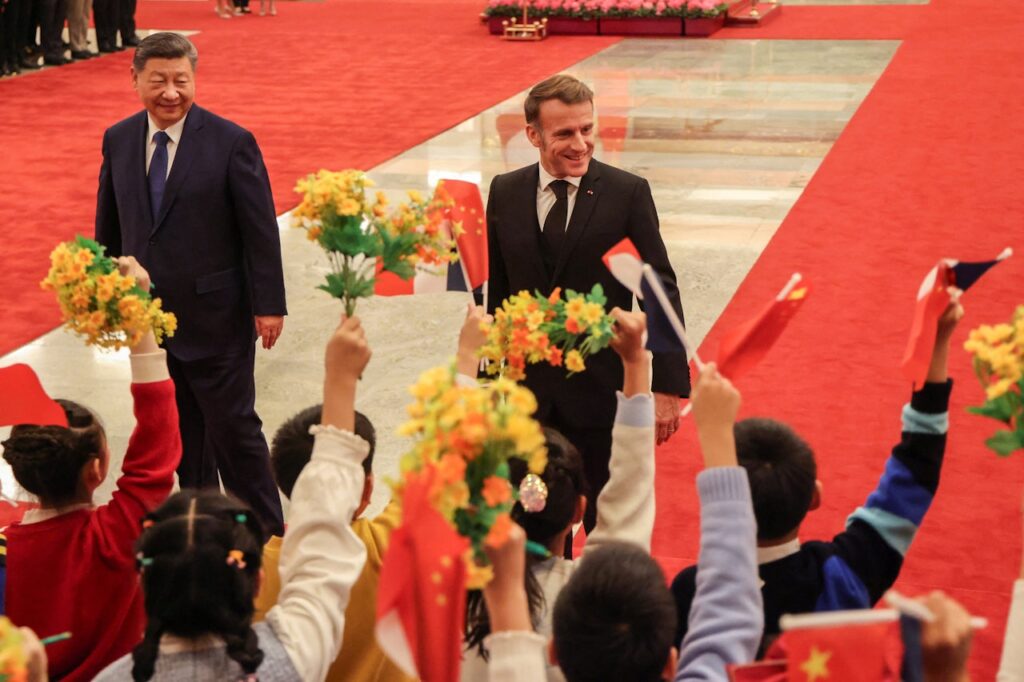
Chinese President Xi Jinping (L) and French President Emmanuel Macron attend a welcome ceremony at the Great Hall of the People in Beijing, China, December 4, 2025. | Photo courtesy of Reuters.
The Event: Macron’s Visit & The Missing 500 Jets. French President Emmanuel Macron’s state visit concluded with a flurry of cooperation agreements, but for the global aviation industry, the outcome was defined by what was absent.
The Official Line: Airbus confirmed that it had received approval to deliver 120 aircraft to Chinese carriers. The Reality: This is not a new order. These are aircraft already in the backlog—metal that has likely already been cut or welded—that were stuck in a bureaucratic holding pattern. The signed “Generic Terms Agreement” (GTA) merely clears the customs and regulatory path for existing commitments.
The “Ghost” Order: For over a year, industry insiders and Wall Street analysts have been tracking a potential mega-order of 500 jets involving the A320neo and A350 families. Historical precedent suggested this visit was the moment. In 2019, during Xi Jinping’s visit to France, China signed for 300 Airbus jets. In 2023, the “Big Three” ordered 292 jets. Despite the high-level diplomatic pressure and the presence of Airbus CEO Guillaume Faury, this 500-jet deal remains frozen.
Tianlux Insight: The Leverage Trap. Why did Beijing withhold the pen? This is a calculated strategic maneuver, not a bureaucratic delay.
- Geopolitical Insurance (The “Nuclear Option”): With the European Union imposing tariffs on Chinese Electric Vehicles (EVs) and the US-China trade war heating up under a renewed Trump administration, a 500-jet order is China’s “nuclear option” for trade leverage. In the poker game of international trade, you do not play your ace card during a courtesy visit. Beijing is saving this order for the trade negotiation table. If Brussels softens its stance on EVs, the Airbus order may reappear. Until then, it remains a tantalizing carrot dangling just out of reach.
- The Duopoly Balance: Beijing is acutely aware of the “Boeing Factor.” While China wants to reward Europe for its relative strategic autonomy, completely shutting out Boeing destroys China’s leverage with Washington. Keeping the Airbus order in limbo keeps both duopoly players hungry. If China committed 500 jets to Airbus today, it would have zero leverage left to use against the incoming US administration next year.
- Domestic Capacity Saturation: The “Profitless Boom” we discussed last week is real. Chinese airlines are flying record passenger numbers but suffering from yield dilution. Injecting 500 new narrowbodies into the market right now would collapse ticket prices further. The CAAC is likely tapping the brakes to allow demand to catch up with existing capacity.
- The “National Champion” Reservation: Perhaps the most critical long-term factor is COMAC. Ordering hundreds of A320neos now would saturate the narrowbody fleet growth for the next five years—precisely the window in which COMAC aims to scale C919 production. Beijing is practicing “Strategic Market Reservation”, deliberately leaving order book gaps to ensure there is hunger for the C919 as it ramps up capacity. Feeding Airbus too much now would starve the C919 later.
The Verdict: The era of “gift-wrapping” multi-billion dollar orders for visiting dignitaries is fading. In 2026, China’s procurement strategy will be transactional, conditional, and piecemeal. Approving deliveries keeps the fleet running and satisfies immediate operational needs; withholding new orders keeps the politicians listening.
POLICY & REGULATION

THEME: THE GREAT CAPITAL SHUFFLE
Drunken Capital: Liquor Money Fuels the Jets. In one of the most unusual cross-industry bailouts of the year, Wuliangye Group, the state-owned producer of China’s famous baijiu liquor, has officially become the second-largest shareholder of Sichuan Airlines Group.
The Deal Structure:
- The Injection: While the registered capital officially jumped to 1.219 billion RMB (US$ 160 million), industry sources estimate the total capital injection at nearly 5 billion RMB (US$ 710 million), with the surplus credited to capital reserves, a clear signal of the premium Wuliangye paid to save the carrier.
- The Split: Wuliangye Group now holds 45.8% of the group, while Sichuan Development (the provincial investment arm) holds 54.2%.
The Financial Reality Check: Why is a liquor company buying an airline? The answer lies in the distressed balance sheet of Sichuan Airlines.
- Insolvency: As of mid-2025, Sichuan Airlines (the operating entity) reported an asset-liability ratio of 100.7%, with net assets of negative 536 million RMB (US$ 76 million).
- The Loss Machine: Despite the traffic recovery, the airline lost 1.18 billion RMB (US$ 170 million) in Q3 alone.
- The “Gambling Agreement” (VAM): The stakes are incredibly high. The parent group has signed a Valuation Adjustment Mechanism (VAM) with China Southern Airlines (which holds 39% of the operating entity). The terms are brutal: Sichuan Airlines must IPO by 2028, or the parent group must buy back China Southern’s shares at cost plus interest.
Tianlux View: Balance Sheet Engineering. This deal represents “Balance Sheet Engineering” with Chinese characteristics. The aviation sector’s debt load is now so toxic that it requires cash injections from cash-rich, high-margin monopoly industries like baijiu to stay afloat. Wuliangye is the perfect “White Knight.” It is a provincial SOE with massive cash reserves and extremely high profit margins (often exceeding 70%). By directing Wuliangye to bail out the airline, the Sichuan provincial government is effectively transferring wealth from its most profitable asset to its most strategic infrastructure asset. It signals that the province views the airline not as a standalone business, but as essential infrastructure that must be saved, even if it means draining the profits of the liquor sector to do it.
The Logistics War Chest: China Post Air. While passenger airlines scramble for bailouts, cargo carriers are loading up on ammunition for a different war.
China Post Air completed a massive capital injection this week, increasing its registered capital by 1.46 billion RMB (US$ 210 million) to a total of 7.3 billion RMB (US$ 1.04 billion).
The Strategic Context: This is the fourth injection in five years. Why the rush?
- Fleet Expansion: With 32 Boeing 737s, 6 Boeing 757s, and only 2 Boeing 777Fs, China Post is still largely a domestic narrowbody player.
- The Competitor: Its primary rival, SF Airlines, operates over 80 freighters and has a much larger widebody fleet.
- The Mission: China Post is the “National Team” of logistics. As cross-border e-commerce (Temu, Shein, TikTok Shop) faces increasing tariff threats and logistics scrutiny in the West, Beijing needs a secure, state-controlled logistics pipe that is not beholden to foreign integrators like FedEx or UPS.
Tianlux Insight: Expect this capital to be deployed immediately into widebody acquisitions. China Post needs more 777Fs or converted A330s to compete on the “Pacific Trunk” routes. This is not just about delivering mail; it is about securing the supply chain for China’s export manufacturing base.
INDUSTRY
THEME: HARDWARE AUTONOMY & INFRASTRUCTURE BETS
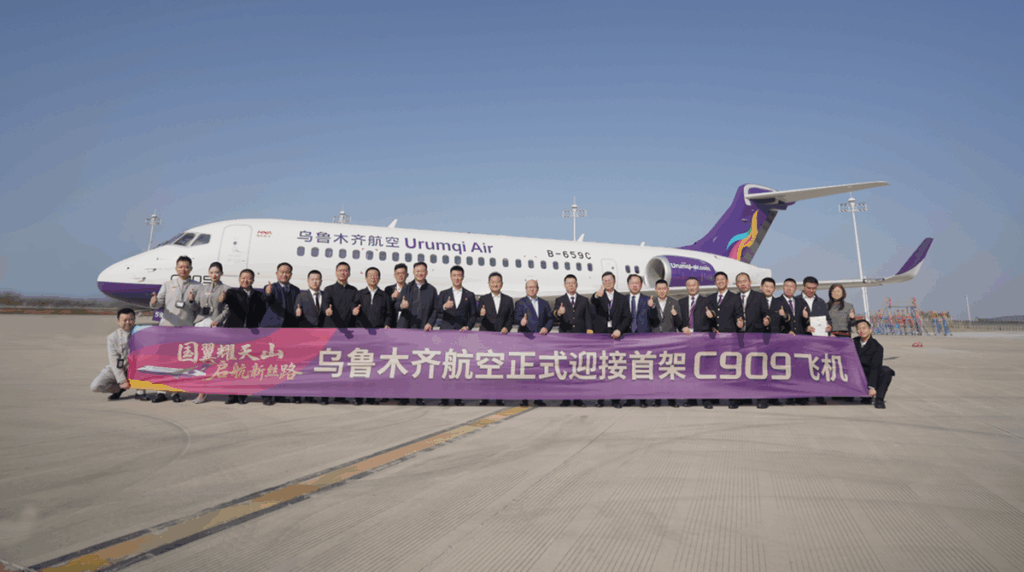
The C909 Goes “Frontier”: A Market Test. On December 8, Urumqi Air received its first C909 (formerly ARJ21), Registration B-659C. This delivery is far more significant than a standard handover.
Why it matters:
- The Ownership Test: Urumqi Air is part of the “New Hainan Airlines,” now controlled by Fangda Group, a private industrial conglomerate known for ruthless cost-cutting. Unlike the “Big Three” state-owned airlines, Fangda operates with a “hard budget constraint.” While the carrier will certainly utilize standard regional subsidies and indigenous aircraft incentives (including direct OEM subsidies from COMAC), it will not tolerate indefinite operational losses for the sake of political prestige. This delivery is a critical stress test: Can the C909 achieve genuine profitability in a cost-sensitive commercial regime, rather than relying on the deep pockets of a central SOE airline or the manufacturer itself?
- Strategic Geography: The aircraft will be deployed in Xinjiang, a region of vast distances and thin routes. Urumqi Air plans to build a “General + Branch” network connecting hubs like Kashgar, Yining, Hotan, and Shihezi.
- Utilization Maturity: This jet is not a showpiece. The C909 fleet has now carried 30 million passengers, proving it has transitioned from “experimental” to “workhorse.”
Tianlux Insight: The deployment of the C909 in Xinjiang is a strategic masterstroke. Xinjiang’s airports are high-altitude and often subject to extreme weather. If the C909 can prove high dispatch reliability here, it validates the platform for export to other rugged markets in Central Asia and the Global South. It is the ultimate “stress test” for Chinese commercial aviation.
The “Oceanic” Ambition: Dalian’s Offshore Hub. While the industry talks about a “profitless boom,” China Southern Airlines is making a massive, long-term infrastructure bet. The carrier initiated tenders this week for its base at the new Dalian Jinzhou Bay International Airport—the world’s largest offshore airport.
The Engineering & Strategic Scale:
- Total Investment: 50.9 billion RMB (US$ 7.22 billion).
- The Site: A 20.87 square kilometer artificial island.
- China Southern’s Commitment: A 72,500 sqm maintenance base and a 39,300 sqm operation center.
- The Timeline: Construction starts Dec 2025, aiming for a 2030 opening.
Tianlux Insight: Why build an airport on the sea in a region (Northeast China) that is facing population decline?
- Technical Necessity: Dalian’s existing airport is landlocked by the city.
- Strategic Gateway: This confirms the “Hub Strategy” is alive and well in the North. Beijing is betting on a long-term recovery of the Japan/Korea/Russia traffic corridors. An offshore airport operates 24/7 without noise curfews, positioning Dalian as the primary cargo and transfer hub for Northeast Asia, rivalling Incheon. It is a 50-year asset play that looks beyond current economic stagnation.
Shenzhen’s Third Runway Opens: The Bay Area Capacity War. On November 29, Shenzhen Airport officially entered the “Three Runway Era”. With a 65 million passenger target for 2025, Shenzhen is aggressively expanding its capacity. The Conflict: This places Shenzhen in direct competition with Hong Kong’s Three-Runway System (which is also ramping up) and Guangzhou’s massive expansion. The Pearl River Delta now has three major hubs fighting for the same airspace and the same passengers. Tianlux View: Expect a fierce battle for international slots. Shenzhen’s new runway allows it to handle more widebodies, directly challenging Hong Kong’s traditional dominance in long-haul international traffic.
LOW-ALTITUDE ECONOMY & eVTOL
THEME: THE REALITY CHECK—SHOW VS. DOUGH
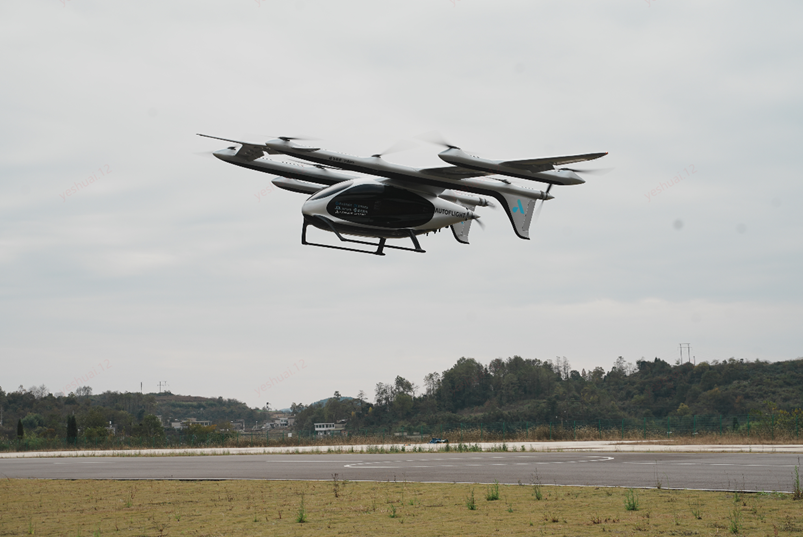
Logistics First, People Second: The Guizhou Breakthrough. While the media fawns over “flying taxis” in urban centers, the real commercial value of the low-altitude economy is being proven in the mountains.
JD Logistics and AutoFlight (Fengfei) completed a milestone flight in Guizhou this week.
The Case Study:
- The Machine: A 2-ton eVTOL (V2000CG “CarryAll”).
- The Mission: Flying 120km across the Guizhou plateau (Guiyang to Huangping), carrying emergency medicine and beef.
- The Economics: The flight took 40 minutes, compared to 3+ hours by road.
- The Context: Guizhou is mountainous (“No three feet of flat land”). Ground logistics are expensive and slow due to winding roads.
Tianlux Insight: This is the “Killer App” for eVTOL in China. Not urban air taxis (which face massive regulatory hurdles and safety concerns), but high-value, time-sensitive logistics in terrain where ground transport is inefficient. The “ton-class” payload capability moves this out of the realm of “drone delivery” (small parcels) and into “air cargo” (industrial supply chain). In 2026, the smart money will flow to these “B2B” logistics scenarios, which are easier to certify and monetize than passenger transport.
The “Show” Flight: Nanjing’s Tourism Loop. In contrast, Nanjing launched a manned eVTOL sightseeing trial at Purple Mountain this week using the EHang EH216-S.
- The Scenario: A closed-loop flight for tourists to view the scenery.
- The Limitation: This is essentially a “digital Ferris wheel.” While visually impressive and good for PR, it does not solve a transport problem. It is a novelty experience.
Tianlux Verdict: We are seeing a divergence in the low-altitude economy. Path A (Logistics): High utility, solving real pain points (Guizhou), scalable unit economics. Path B (Tourism): High visibility, restricted by safety regulations, dependent on subsidy or high ticket prices (Nanjing). Investors should bet on the boxes (logistics), not the bodies (passenger transport), for the next 3-5 years.
ICYMI: SIGNALS IN THE NOISE
The Antipode Link: Shanghai to Buenos Aires. China Eastern has launched the world’s longest single-flight milk run: Shanghai—Auckland—Buenos Aires. This 20,000km route fills a massive gap. The Signal: This is geopolitical connectivity masquerading as a flight route. It creates a “Southern Corridor” linking China to Latin America via New Zealand, bypassing traditional North American / European transfer hubs. Crucially, it secures the logistics chain for high-value imports like cherries and salmon, proving that aviation network planning is now a subset of China’s food security and trade strategy.
GE’s “In China, For China” Pledge. Celebrating its 45th anniversary in China, GE Aerospace reaffirmed its deep integration. The Stat: GE engines power the C919 (LEAP-1C) and ARJ21 (CF34), logging 19.7 million flight hours annually in China. The Signal: Despite decoupling rhetoric, the interdependence remains absolute. COMAC cannot fly without GE, and GE cannot ignore its largest growth market. The “MRO (Maintenance, Repair, and Overhaul) Network” GE is building in Shanghai is a “poison pill” against sanctions, it embeds the US manufacturer so deeply into the Chinese ecosystem that untangling it becomes commercially suicidal.
Visa-Free Dividends: Qingdao’s Surge. One year into the visa-free policy for South Korea, Qingdao Airport reports a 63.3% surge in inbound Korean travelers. The Insight: Policy works. Removing friction creates immediate traffic. We expect similar spikes from the new visa-free policies for Japan (recently reinstated) and other nations in 2026. This is the low-hanging fruit for boosting airport revenues amidst the “Profitless Boom.”
Contact us with tips, pitches and feedback.

Our Service
We bridge insight, expertise, and trusted networks to help our clients navigate China’s evolving aviation landscape.

We help Chinese aviation enterprises and investors manage international exposure, partnerships, and certification risks through tailored consulting and market insight.

We compile and interpret aviation developments between China and the world, turning fragmented information into structured, fact-based analysis for decision-makers.

We provide discreet, insight-driven advisory based on trusted relationships and a deep understanding of global aviation stakeholders.