December 17, 2025
by Wu Yunzhe
WELCOME TO TIANLUX OBSERVATIONS. Read more about our mission. Covering the week of Dec 10-16.
We are diving deep into the structural re-alignment of Chinese aviation as Beijing’s State Assets Watchdog (SASAC) forces a return to the center stage. This week, we analyze why a new state mandate to “focus on core business” is objectively marginalizing the lighter end of the private eVTOL market. Armed with military-grade engine cores and “Patient Capital,” state giants are clearing a field that private innovation once thought it owned.
Will the state assets watchdog’s new mandate to “resist involution” finally restore yield to Chinese aviation, or will it simply create a closed-loop monopoly that starves the very private innovation that started the low-altitude boom? Email wu.yunzhe@tianlux.com with tips, pitches, and feedback.
HEADLINE OF THE WEEK: THE RE-CENTRALIZATION MANDATE: STATE CAPITAL SECURES THE STRATEGIC HIGH GROUND
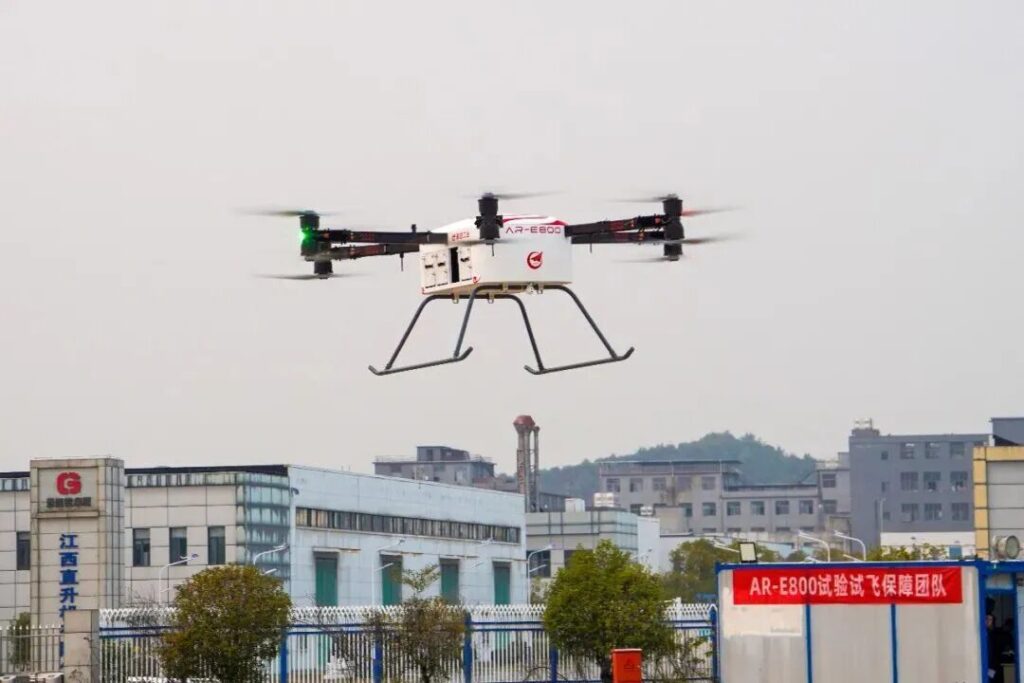
The AR-E800 heavy-lift eVTOL stands at Jingdezhen High-tech Airport following its successful maiden flight on December 10, 2025, serving as a microcosm of China’s "National Team" entering the low-altitude economy to secure strategic industrial hardware. | Photo courtesy of AVIC.
The Event. On December 12, 2025, the State-owned Assets Supervision and Administration Commission (SASAC), Beijing’s State Assets Watchdog, issued a high-level directive. Central government level State-Owned Enterprises (SOEs) must “consciously resist ‘involutionary’ competition” and “focus on their core business.” While framed as a call for efficiency, it is a fundamental re-centering of the industry.
The Strategy of Concentration. In an era of de-risking, Beijing has concluded that the “low-altitude economy” is too strategically vital to be left to the fragmented whims of private venture capital. By ordering the “National Team” (AVIC, COMAC, and AECC) to focus on high-end hardware, the state is forcing a massive concentration of resources. The objective consequence: a significant strategic hurdle for private players who lack the capital depth to compete in the “new” era.
Evidence of the “Heavy Metal” Takeover. The physical proof of this state pivot arrived this week with two historic maiden flights that showcase the technical and capital advantage of the SOEs:
- The “Jiutian” (High Sky) Heavy UAV. On December 11, this 16-metric-ton behemoth completed its maiden flight in Shaanxi. Designed by AVIC’s First Aircraft Institute, it is a strategic “mothership” with a 6-ton payload and a modular “Honeybee” bay capable of launching swarms of loitering munitions.
- The AR-E800 Heavy eVTOL. Simultaneously, AVIC’s AR-E800, the nation’s first 800kg-class heavy-lift electric aircraft, successfully flew in Jingdezhen. Unlike private prototypes designed for “cool” air-taxi renderings, the AR-E800 is a rugged tool built for industrial tasks like mountain power line construction and emergency rescue.
The Capital Disparity. The state is not competing on agility; it is competing on the size of its balance sheet. While private eVTOL startups face a liquidity desert in the global VC market, SOEs have access to “Patient Capital.” Take the recent 44 billion RMB (US$ 6.2 billion) state injection into COMAC as a benchmark. This level of liquidity allows state players to focus on decade-long strategic mandates rather than the quarterly ROI that constrains private firms. When the State Assets Watchdog decides a sector is a priority, the funding is effectively bottomless.
Tianlux View. The “Anti-Involution” doctrine is the official end of the “Market-First” era in Chinese aviation. Beijing has concluded that fragmented private capacity cannot substitute for the industrial scale of a state giant like AVIC in terms of national security. By consolidating power under the watchdog’s mandate, the state is creating an industrial “Closed Loop.” Private OEMs are no longer just competing with each other: they are facing a state that is the lead competitor, the primary regulator, and the ultimate customer.
POLICY & REGULATION: THE CAAC’S ROADMAP—FROM EXPERIMENTS TO PREDICTABLE PATHWAYS
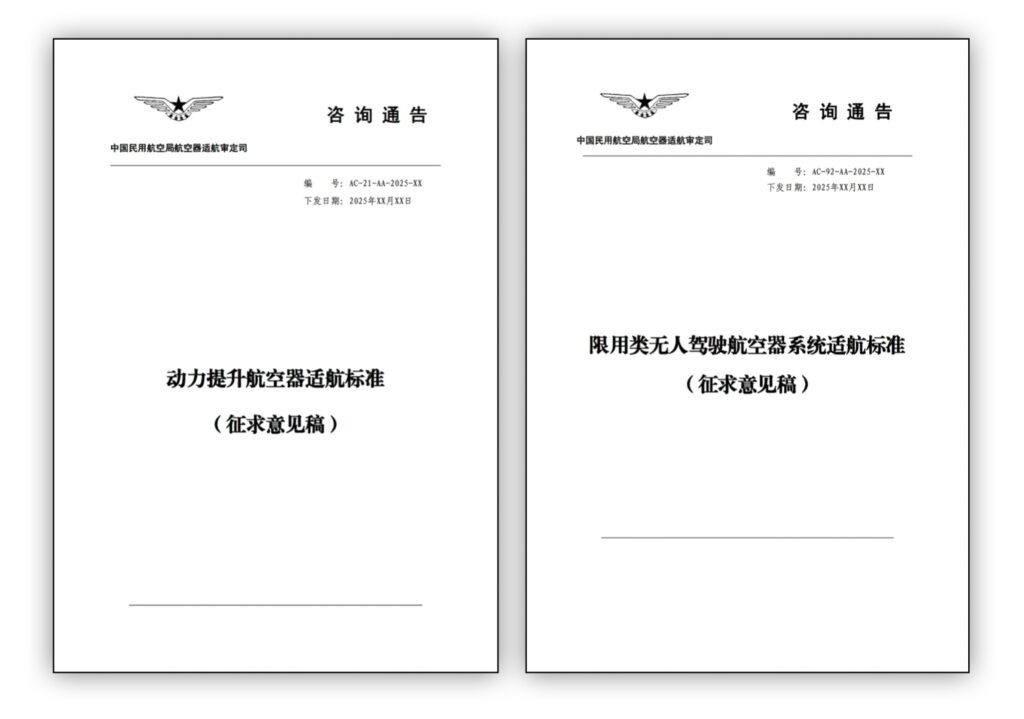
The News. Earlier this week, the Civil Aviation Administration of China (CAAC) released two consultation drafts that are far more important than they may look at first glance:
- 𝗔𝗶𝗿𝘄𝗼𝗿𝘁𝗵𝗶𝗻𝗲𝘀𝘀 𝗦𝘁𝗮𝗻𝗱𝗮𝗿𝗱𝘀 𝗳𝗼𝗿 𝗣𝗼𝘄𝗲𝗿𝗲𝗱-𝗟𝗶𝗳𝘁 𝗔𝗶𝗿𝗰𝗿𝗮𝗳𝘁 (𝗖𝗼𝗻𝘀𝘂𝗹𝘁𝗮𝘁𝗶𝗼𝗻 𝗗𝗿𝗮𝗳𝘁)
- 𝗔𝗶𝗿𝘄𝗼𝗿𝘁𝗵𝗶𝗻𝗲𝘀𝘀 𝗦𝘁𝗮𝗻𝗱𝗮𝗿𝗱𝘀 𝗳𝗼𝗿 𝗥𝗲𝘀𝘁𝗿𝗶𝗰𝘁𝗲𝗱 𝗖𝗮𝘁𝗲𝗴𝗼𝗿𝘆 𝗨𝗻𝗺𝗮𝗻𝗻𝗲𝗱 𝗔𝗶𝗿𝗰𝗿𝗮𝗳𝘁 𝗦𝘆𝘀𝘁𝗲𝗺𝘀 (𝗖𝗼𝗻𝘀𝘂𝗹𝘁𝗮𝘁𝗶𝗼𝗻 𝗗𝗿𝗮𝗳𝘁)
The Framework. This is the first time the CAAC has put clear, dedicated certification rulebooks on the table for two very different futures of advanced aviation.
For powered-lift aircraft: This draft is essentially China’s first complete regulatory framework for eVTOLs. It clearly defines the target aircraft: piloted, pure electric, distributed propulsion, VTOL capability, fixed-wing cruise, under 5,700 kg, and up to 9 seats. If you are building a passenger eVTOL, this document is basically telling you: “This is the lane you will be certified in.”
More importantly, the safety philosophy is no longer theoretical. The draft explicitly talks about concepts like critical power loss, continued safe flight and landing, and controlled emergency landing. The message mirrors EASA SC-VTOL & FAA powered-lift policy: Failures are expected. What matters is whether the aircraft can manage them in a predictable and survivable way.
On the unmanned side: Once this standard takes effect, it will replace the 2024 trial version. In practice, this means China is moving its oversight from an experimental phase into a more stable and standardized regime. Instead of manned-aircraft certification, CAAC focuses on where and how they fly: defined operating scenarios, containment areas, recovery zones, command-and-control links, and structured test programs. The underlying logic is straightforward: You do not need transport-category safety, but you must clearly show how risks are contained and verified.
Tianlux Insight. The CAAC is shifting from ad-hoc exemptions to predictable pathways broadly aligned with EASA/FAA. For anyone working on eVTOL, powered-lift aircraft, or advanced UAS platforms with eyes on the China market, this is not just a regulatory update. It is a roadmap.
INDUSTRY & OEM: SELECTIVE INTEGRATION AND DIGITAL SOVEREIGNTY

The Event. Even as the state squeezes private domestic capital, it remains hungry for high-end Western technical partnerships. This week saw two critical milestones: the official commencement of BAESL (Rolls-Royce/Air China) and the formation of Aerospace Star Yuan Digital Technology (CASC/Dassault Systèmes).
Case Study: BAESL and the MRO Fortress. On December 10, the Beijing Aircraft Engine Services Co., Ltd. (BAESL) officially opened its 80,000-square-meter facility. This is a $315 million bet on localizing the highest-value part of the widebody supply chain.
- The Mission. Targeting 250 engine shop visits per year by 2034, focusing on the Trent XWB-84 (A350) and Trent 1000 (B787).
- The Context. Nearly 600 Trent engines are in service with Chinese carriers, representing 20% of Rolls-Royce’s global widebody deliveries. With global MRO slots backlogged by 12-24 months, BAESL gives Air China a “dedicated lane.”
Case Study: CASC x Dassault Systèmes. On December 11, 2025, a landmark joint venture, Aerospace Star Yuan Digital Technology, was officially established in Shanghai. This €20 million (160 million RMB) investment represents a deepened structural alliance between Aerospace Software, a subsidiary of the China Aerospace Science and Technology Corp (CASC), and France’s Dassault Systèmes.
- The Mission. The new entity is registered to provide high-end information technology consulting, software sales, and digitalization services. Its primary objective is to leverage the 3DEXPERIENCE platform to accelerate CASC’s digital transformation, enhancing its digitalization and intelligent manufacturing capacities for complex aerospace systems.
- The “Sovereign Digital Wrapper.” This JV acts as a localized bridge, allowing the “National Team” to integrate world-class Product Lifecycle Management (PLM) tools, such as CATIA and ENOVIA, within a controlled domestic framework. By managing these “Digital Brains” through a local joint venture, CASC secures a pathway to global technical standards while ensuring data compliance within a sovereign infrastructure.
Tianlux View. Beijing is practicing “Selective Integration.” While the State Assets Watchdog is squeezing domestic private competition to avoid “involution,” it remains highly receptive to top-tier Western technology when it serves the narrative of national hardware sovereignty. The formation of Aerospace Star Yuan signals that for the most critical strategic sectors, China prefers a “Sovereign Wrapper” over isolation, doubling down on global leaders to power its industrial base.
LOW-ALTITUDE & eVTOL: THE MARKET RESPONSE: SEEKING DIFFERENTIATION
The Context. While the “National Team” (AVIC) debuted its heavy-hitters (Jiutian/AR-E800), private players are scrambling to find niches that state capital hasn’t yet dominated.
The Weight-Class Push: Vector 5. Dimension 5 (Vector 5) has officially entered the Type Certificate (TC) phase for its 3-ton eVTOL. This is a strategic leap.
- The Pivot: By moving into the 3-ton class, Vector 5 is targeting inter-city logistics and medical evacuation—sectors where commercial utility outweighs the “air taxi” hype.
- The Barrier: Developing a 3-ton aircraft under the CAAC’s new “Powered-Lift” standards requires a level of engineering redundancy that will test the limits of private balance sheets.
Configuration Innovation: Dragonfly Wing. “Dragonfly Wing” completed its first tethered flight for a 2-ton tilt-rotor eVTOL—the first of its kind in China.
- Technical Risk: Tilt-rotor is notoriously difficult to certify (see: V-22 Osprey), but it offers the speed and range that state-owned multi-rotors lack. This is “Differentiated Competition” in action.
Capital & Ecosystem: Volant and Haige.
- Volant: Named one of the “2025 Shanghai Top 50 Most Potential Investment Startups.” While private, Volant’s tie-in with the Shanghai industrial cluster makes it a prime candidate for future state-led consolidation.
- Haige Communications (002465.SZ): Showcased its “Teng-Shu-Kan” platforms. As a state-linked firm, Haige is building the “digital backbone” for governance and drone traffic management—positioning itself as the landlord of the low-altitude sky.
- Hanjing Innovation x Huizhou Unicom: A new agreement to land heavy-lift drones in the “Sky Intelligence City.” This highlights how private players are surviving by becoming the “service arm” for local government infrastructure projects.
Tianlux View. We are witnessing a divergence. The “lightweight” eVTOL market is becoming a commodity. The “heavyweight” market (2-3 tons) is where the strategic value lies, but the hurdle has moved from “flying a prototype” to “proving safety redundancy” to the CAAC. Private capital is now forced to choose: compete with the National Team on payload, or pivot to become the digital/service providers for state-owned infrastructure.
ICYMI: SIGNALS IN THE NOISE
China Eastern’s India “Daily Blitz.” Just one month after relaunching the Shanghai-Delhi route (MU563/564), China Eastern (MU) has increased the frequency to Daily starting January 2, 2026.
- The Signal: With a 2.5x traffic imbalance (Indians-to-China), MU is locking in the “Hub Habit” for the pharma and tech sectors. While Air China and China Southern remain frozen, MU’s first-mover advantage is a rare case of an SOE acting with market agility.
Hainan Airlines (HNA): The Retail Investor Lock-in. HNA Holding (600221.SH) is offering a 10% ticket discount to shareholders holding 100,000+ shares.
- The Verdict: This is “Liquidity Management.” With the stock at 1.72 RMB (US 24¢, Dec. 16 closing price), it signals that despite a 3.47 billion RMB (US$ 493 million) Q1-Q3 profit, the “Fangda-era” HNA still lacks deep institutional trust and must rely on retail gimmicks to stabilize its capital.
Riyadh Air and the Digital Silk Road. The Saudi startup Riyadh Air signed a Digital Ecosystem MoU with Huawei this week.
- The Insight: Riyadh Air is bypassing Western GDS to plug directly into Huawei’s 20% share of the Chinese smartphone market, a blueprint for non-aligned airlines to capture Chinese travelers at the source.

Our Service
We bridge insight, expertise, and trusted networks to help our clients navigate China’s evolving aviation landscape.

We help Chinese aviation enterprises and investors manage international exposure, partnerships, and certification risks through tailored consulting and market insight.

We compile and interpret aviation developments between China and the world, turning fragmented information into structured, fact-based analysis for decision-makers.

We provide discreet, insight-driven advisory based on trusted relationships and a deep understanding of global aviation stakeholders.