
December 31, 2025
by Wu Yunzhe
WELCOME TO TIANLUX OBSERVATIONS. Read more about our mission. Covering the week of Dec 24-31.
The Architecture of Control: Formalizing the Digital Fence. As 2025 concludes, the Chinese aviation sector is prioritizing governance over growth. The primary story of the week is the formal legislative enclosure of the industry. On December 27, the National People’s Congress Standing Committee (China’s top legislature) adopted a sweeping revision to the Civil Aviation Law. This represents the most profound systemic restructuring since the law’s inception in 1995. The final week of the year is not about the holiday rush: it is about the structural transition from a recovery phase to a “fortress” phase.
While the global industry pauses for the holidays, Beijing is stress-testing its next growth phase in real time. The focus has shifted from raw volume to enforceable governance: law-level authority, mandatory airworthiness standards for UAVs, and a “System Audit” regime for manufacturers. In commercial aviation, the certification of the C909 Firefighter and the 94.1 billion RMB capitalization of COMAC signal a move toward absolute hardware sovereignty. However, the operational reality of the “December Surge” proves that industrial maturity cannot be bought with capital alone.
The Stress Test. As China builds its “Digital Fence” around the low-altitude economy and large jets alike, a central question remains: Will a “governability-first” approach unlock the scale needed for the 15th Five-Year Plan, or will it lock the market down under the weight of compliance? Email wu.yunzhe@tianlux.com with tips, pitches, and feedback.
HEADLINE OF THE WEEK: The Legislative Enclosure: Decoding The 2025 Civil Aviation Law
The Legislative Hammer: July 1, 2026, as the New Horizon. On December 27, 2025, the 14th National People’s Congress Standing Committee adopted a sweeping revision to the Civil Aviation Law. This is the most profound systemic restructuring since the law’s inception in 1995, marking a transition from “auditing products” to “auditing systems.” By establishing mandatory Design Organization Approval (DOA) and Production Organization Approval (POA), the state is creating a high-cost “Compliance Moat” that favors established state-owned enterprises (SOEs) over fragmented private capital.
The “System Audit” Revolution: DOA and POA. The revision establishes a new “Dual-Pillar” institutional framework for aviation manufacturing. It shifts the regulatory focus from “nanny-style” product inspection to system-based oversight.
- Design Organization Approval (DOA): Article 25 mandates that entities engaged in aviation product design must establish a Design Assurance System (DAS) and obtain a DOA. This is a move toward international standards but with Chinese characteristics: it grants the regulator the power to audit the “brain” of the company, not just its output.
- Production Organization Approval (POA): Article 28 requires manufacturers to establish a quality system and obtain a POA to self-issue airworthiness tags. This effectively makes the manufacturer the primary party responsible for quality.
- The Strategic Verdict: This transition is a gift to mature entities like COMAC. By allowing companies to self-certify under a state-approved system, the CAAC is accelerating production for those it trusts. Conversely, it places an existential compliance burden on smaller private firms. Only the best-capitalized players can afford the overhead of these mandatory systems.
Mandatory Airworthiness: The Death of the “White-Label” Drone. For the first time, Article 34 explicitly integrates Unmanned Aerial Vehicles (UAVs) into the airworthiness framework.
- The Mandate: All civil UAV design, production, and operation must apply for airworthiness licenses, unless specifically exempted.
- The Squeeze: This requirement transforms drone manufacturing from a consumer-electronics play into a high-stakes aerospace regulatory play. It favors state-aligned champions who possess the bureaucratic bandwidth to fund multi-year “System Audits.”
PMA Legalization: Breaking the Western Monopoly. Article 29 grants legal equality to Parts Manufacturer Approval (PMA) parts.
- The Strategy: Historically, Western OEMs held a monopoly on replacement parts through restrictive licensing. By elevating PMA parts to legal parity with OEM parts, Beijing is supporting the domestic “aftermarket” supply chain.
- The Goal: To lower the operating costs for Chinese airlines while reducing vulnerability to Western export controls. This is “Hardware Sovereignty” at the component level.
Tianlux Insight: Regulation as the Moat. The Dec 27 law revision is an industrial policy disguised as safety. By shifting to “Systemic Governance” (DOA/POA), Beijing is ensuring that only “National Champions” with the resources to build massive assurance systems can thrive. In 2026, the competitive advantage will shift from “Innovation” to “Compliance Capability.” If you cannot navigate the NPC’s new legal framework, your technological lead is a liability.
POLICY & REGULATION: The GBA’s Unified Low-altitude Roadmap
The GBA Coordinated Sprint. Between December 25 and 29, the Greater Bay Area (GBA), comprising Guangdong, Hong Kong, and Macao, released a landmark policy package designed to harmonize the region’s low-altitude economy. This is the first time these three jurisdictions have synchronized airspace reform and technical standards at such a granular level.
- The Scale of the Cluster: Guangdong now hosts approximately 15,000 companies in the low-altitude value chain, representing roughly 30% of China’s total industrial footprint in this sector.
- The Economic Gravity: In 2024, the province’s low-altitude industrial scale surpassed 100 billion RMB ($14 billion USD), supported by the production of nearly 700,000 civilian drones.
- The Centralization Signal: The new package introduces 12 targeted financial support measures and four provincial-level technical standards. By establishing these standards this week, Guangdong is effectively “locking in” the operational template for the rest of the nation.
Integrated Oversight: The Guangzhou Platform. On December 25, the region officially unveiled the “Guangzhou Low-Altitude Flight Comprehensive Management Service Platform.”
- The “One-Link” Solution: This platform integrates data from national, military, and civil aviation systems into a single interface for flight reporting, warnings, and data sharing.
- The Approval Pivot: It moves toward a “One-Window Acceptance” model for flight approvals, aiming to eliminate the multi-department bureaucratic maze that has historically hindered rapid deployment.
- The Catch: Access to this streamlined system is contingent on total data-sharing. To fly within the GBA, private OEMs must now hand over their real-time operational data to the state-controlled platform.
Tianlux View: The End of Local Autonomy. The coordination seen this week in Guangzhou signals the end of the “sandbox” era for local governments. The GBA is no longer a collection of experimental zones; it is becoming a single, regulated air-corridor. For global investors, the signal is clear: the state has successfully centralized the “brain” of the low-altitude economy. Success in 2026 will be defined by the ability to integrate into this unified, state-led digital governance framework rather than by isolated technological innovation.
INDUSTRY & OEM: COMAC’s Production Ceiling And The Airbus Hedge
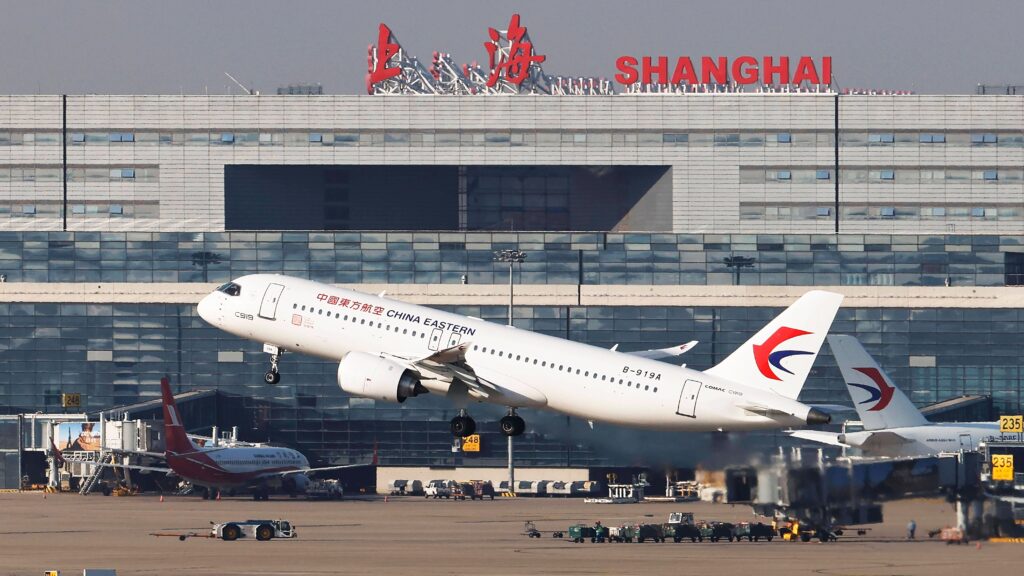
COMAC’s 2025 Scorecard: Ambition vs. Production Reality. The final delivery tally for COMAC in 2025 reached 41 aircraft, comprising 16 C919s and 25 C909s (formerly ARJ21). While the absolute volume for the C919 has technically grown, rising from 12 units in 2024, 3 in 2023, and the inaugural 1 in 2022, the figures represent a sharp divergence from industrial expectations.
- The Scaling Crisis: COMAC entered 2025 with public plans to deliver approximately 30 C919s and scale annual capacity toward 50 By March, internal ambitions were reportedly lifted toward 75 aircraft annually. As Tier-1 supply bottlenecks and component dependencies persisted, these targets were revised downward to 25, before ultimately landing at 16. This shortfall proves that while capital is abundant, industrial repeatability remains the ultimate bottleneck.
- The December Surge: Borrowing from the Future. In a desperate year-end push, COMAC delivered 12 aircraft in December alone: 8 C909s and 4 While this ties the monthly record set in December 2022 (which saw 12 ARJ21s), the industrial complexity of four C919s makes this a far more significant feat. However, investors should view this as a classic OEM “surge”: a practice of “borrowing from the future” that often results in an exhausted production line and a significant lull in the first quarter of the following year.
- The Maturity Trend: Despite the shortfall, the C919’s trajectory remains superior to its predecessor. In its 4th year of delivery, the C919’s 16 units far outpaced the C909’s 6 units at the same stage. The team is demonstrating greater industrial maturity, even as it remains chained to a global supply chain that prioritizes the Western duopoly.
Specialized Sovereignty: The C909 Firefighter. On December 30, the C909 Firefighter project officially received its airworthiness approval at COMAC’s Jiaxing base.
- The First Real Order: Success Aviation immediately signed for 6 units (3 firm, 3 options) at a list price of approximately 270 million RMB ($38.6 million USD) per unit.
- The Verdict: This is a high-stakes industrial breakthrough. By breaking the Western and Russian monopoly on jet-powered aerial firefighting, China is establishing “Mission-Critical” hardware sovereignty. This high-margin niche allows COMAC to build operational depth without competing directly with the A320neo on yield.
Operationalizing the Corridor: Xinjiang Expansion. Also on December 30, Urumqi Air launched its inaugural C909 flights on two routes: Urumqi-Karamay-Hotan and Urumqi-Fuyun. Xinjiang’s harsh geography is the ultimate proving ground, signaling that the C909 has transitioned from a recipient of “Political Support” to a piece of “Essential Infrastructure.”
The $8.2 Billion Reality Check: Why Airbus Still Wins. The market’s response to COMAC’s production ceiling was finalized this week. On December 29 and 30, Spring Airlines announced the purchase of 30 Airbus A320neo jets ($4.13 billion), followed by Juneyao Air with 25 jets ($4.1 billion). On December 30, Air China also confirmed its order for additional A320neo series aircraft.
- Strategic Hedging: These orders are the commercial realization of the framework discussed during President Macron’s state visit. With deliveries scheduled for 2028-2032, these carriers are signaling that they cannot gamble their 2030 growth solely on COMAC’s immediate scaling.
- The Hardware Fortress: These new orders will eventually join the massive state-owned fleets which, as of December 31, define the market’s “Hierarchy of Power.” The Air China Group now oversees 983 aircraft (566 core), the China Southern Group commands 970 (712 core), and the China Eastern Group reaches 851 (607 core). Together, these “Big Three” control over 2,800 airframes, acting as a sovereign buffer against market volatility.
The Year-End Capitalization. COMAC concluded 2025 with its finalized registered capital of 94.1 billion RMB ($13.3 billion USD). While the injection was completed earlier in Q4, the finalized year-end balance sheet provides the “clean sheet” necessary for the 15th Five-Year Plan.
Tianlux Insight: The Maturity Signal. The C909 Firefighter certification and the Xinjiang deployment prove COMAC is maturing into a multi-role OEM. However, the production shortfall for the C919 remains the elephant in the room. The Airbus orders by Spring and Juneyao are the industry’s vote of “No Confidence” in the immediate scaling of domestic narrow-bodies. The state is building the fortress, but the market is still buying the bridge.
LOW-ALTITUDE & eVTOL: The Infrastructure Sprint
The 1,200 Vertiport Mandate. On December 25, Shenzhen confirmed its plan to build over 1,200 takeoff and landing sites by 2026. This is a direct response to ground-level saturation at hubs like Shenzhen North, which handled 116 million passengers in the first 11 months of 2025.
Centralized Competition. Guangdong, Shaanxi, and Chongqing have released coordinated plans, assigning Shaanxi “manufacturing,” Chongqing “mountain testing,” and Guangdong “commercialization.” Redundancy is being eliminated by state decree.
Tianlux View: The “State-Led” Gold Rush. The money is flowing, but only through state-controlled “Development Divisions.” The 15th Five-Year Plan has turned the low-altitude economy from a tech play into a “Funded Mandate.”
Globally, leading e
ICYMI: SIGNALS IN THE NOISE
Cathay’s 80-Year “Retro” Hedge. On December 28, 2025, Cathay Pacific unveiled a retro “Lettuce Sandwich” livery: green and white stripes inspired by its early designs. While mainland carriers focus on buying new Airbus metal, Cathay is selling “Heritage and Brand.” In a market of commoditized yield, Cathay is betting that its history as a global connector is its most valuable asset for the next five years.
The Decarbonization Divergence. On December 31, 2025, China and Russia formally denounced a landmark UN deal intended to cap emissions from international flights. While individual airports like Kunming continue to secure AIIB financing for “green and low-carbon development,” Beijing is signaling that it will not allow global environmental mandates to penalize its emerging-market growth. This is a blunt signal: China supports a climate plan, but only one that does not raise costs for its domestic carriers as they expand globally.
The “Three-Runway” Club Expands. On December 25, 2025, Xi’an Xianyang International Airport put its third runway into operation. This milestone brings the total number of three-runway airports in China to 11, following similar 2025 expansions in Wuhan, Lanzhou, and Urumqi. Despite the “Profitless Boom” where major airport groups are struggling with massive deficits, the state refuses to pause its infrastructure sprint, treating concrete runways as comprehensive economic nodes rather than mere transport hubs.
Chengdu’s Volume Paradox. On December 31, 2025, the Chengdu International Aviation Hub (comprising Shuangliu and Tianfu airports) processed its 90 millionth passenger of the year. While local authorities celebrate the 10.5% increase in total transportation turnover, this vanity metric epitomizes the industry’s core struggle: processing record-breaking volumes while yield-per-passenger remains dangerously thin.
The risk is not a slow downturn. It is sudden corridor shutoff concentrated in thinner city pairs. For planners, this forces a shift from “optimize for demand” to “optimize for resilience,” with more emphasis on hubs, alliance routings, and markets where policy risk is lower.

Our Service
We bridge insight, expertise, and trusted networks to help our clients navigate China’s evolving aviation landscape.

We help Chinese aviation enterprises and investors manage international exposure, partnerships, and certification risks through tailored consulting and market insight.

We compile and interpret aviation developments between China and the world, turning fragmented information into structured, fact-based analysis for decision-makers.

We provide discreet, insight-driven advisory based on trusted relationships and a deep understanding of global aviation stakeholders.