November 17, 2025
WELCOME TO TIANLUX OBSERVATIONS. Read more about our mission. Covering the week of Nov 10-16.
Good morning from Shanghai. Tianlux follows where China’s aviation policy, money, and geopolitics meet, and what that means for the people who have to act on it.
The Focus: This week, we look beyond the borders. While the Western duopoly fights over backlogs, we track how Chinese capital is quietly paving the runway for Chinese aircraft in Southeast Asia, and where that strategy hits its limits.
HEADLINE OF THE WEEK: COMAC'S SOUTHEAST ASIAN FOOTPRINT, AND ITS LIMITS
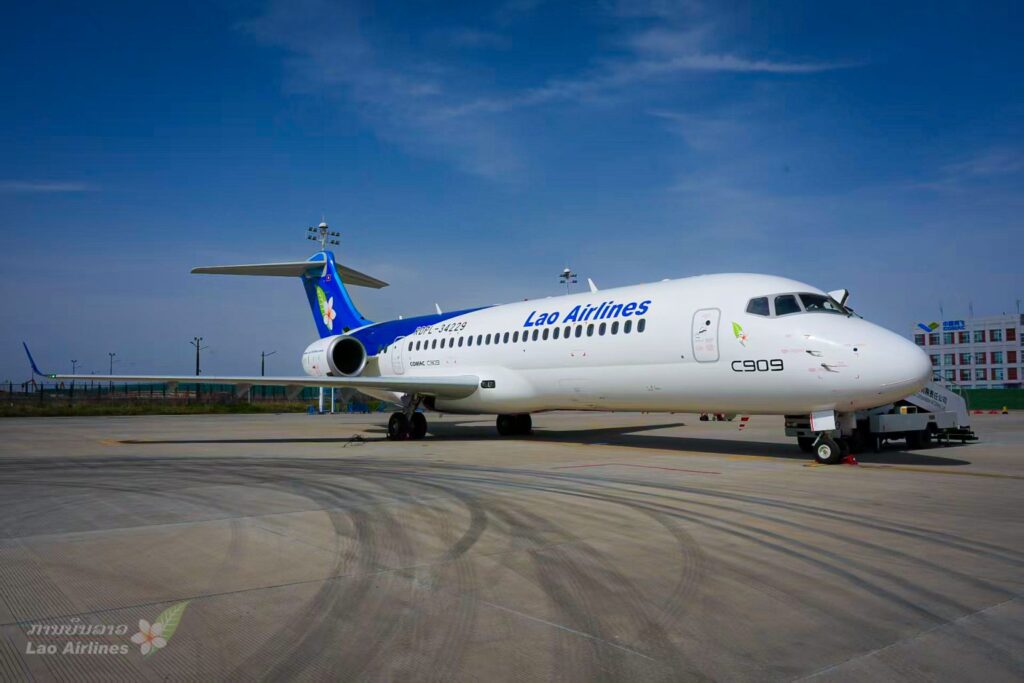
COMAC completes its 49 percent acquisition of Lao Airlines this week, effectively turning the flag carrier into a Chinese-controlled subsidiary. | Photo courtesy of Lao Airlines.
Southeast Asia is where COMAC is learning what it really means to be a global OEM. While Boeing and Airbus fight over narrow body backlogs, Chinese built regional and single aisle jets are quietly showing up on more route maps from Indonesia to other ASEAN countries.
The Optical Breakthrough. On paper, the operator list is getting longer. Indonesia’s TransNusa became the first overseas airline to fly the C909, the rebranded ARJ21, onto the core Jakarta–Bali trunk and rotating it across a Bali-centred network. Lao Airlines has followed as the second, planning Vientiane to Kunming services with the same type after regulators cleared CAAC certified aircraft to enter the fleet. In Brunei, startup GallopAir has signed an intention order for 15 C909s and 15 C919s, backed by a regulatory change allowing CAAC certified types to be flown by Bruneian operators.
Cambodia is lining up as the next piece. Air Cambodia, backed by Chinese capital and positioned as a new national carrier, is marketing a future fleet built around the C909 from the second half of this decade. That means, on a route map, you now see COMAC metal tied to at least four Southeast Asian flags: Indonesia, Laos, Brunei and Cambodia.
On a slide deck, that looks like a clean regional breakthrough. However, the ownership structure tells a more complicated story.
The Hidden Ledger: Capital Travels with Aircraft All of these “overseas” wins are heavily anchored in Chinese money or control.
- Lao Airlines: Reuters reporting shows COMAC has proposed taking a majority stake in debt laden Lao Airlines as part of its aircraft deal, turning Laos’ flag carrier into a quasi captive customer.
- GallopAir: Its launch model relies on Chinese financing and close coordination with COMAC.
- TransNusa: Its C909s arrived through Chinese lessors.
- Air Cambodia: Its business plan is built around Chinese investors from day one.
The Insight: In other words, the first wave of Southeast Asian operators looks less like independent foreign customers and more like an extended home market where Chinese capital travels with Chinese aircraft.
The Commercial Stress Test: Vietjet. Vietjet is the reminder that orders and operations are not the same thing. The Vietnamese low cost carrier took two C909s on a short term wet lease for high demand leisure routes between Hanoi, Ho Chi Minh City and Con Dao, using Chengdu Airlines crews and Chinese maintenance support.
After roughly six months, it chose not to extend the arrangement, citing the cost of foreign crews and offshore maintenance as the main reason. Public reporting has not flagged major technical or safety problems with those flights, the issue was that the cost structure did not work for a price sensitive carrier on short domestic legs.
A month later, Vietjet appears to be stepping back in. New reporting indicates that the airline is preparing to renew a six month wet lease with Chengdu Airlines and bring the C909 back into service on the Con Dao route, where short runway constraints and holiday demand make aircraft choice more complicated. This turns Vietjet from a simple negative verdict into a rolling case study in how commercial airlines may switch in and out of the type as economics, demand and politics shift.
The Real Test: That is COMAC’s real test. It is not simply whether the aircraft can be certified and flown, it is whether airlines still want them once promotional leases end and the support model has to stand on its own balance sheet.
The Logistics Gap Regulatory recognition helps but does not close the gap. Vietnam and Brunei adding CAAC to their list of accepted authorities makes it legally possible for local airlines to fly C909s and C919s. It does not automatically create type rated pilot pools, spare parts stock close to the line, or local MRO hangars that can turn aircraft around quickly after technical issues.
Airbus and Boeing did not win Asia on performance alone. They layered aircraft sales on top of training centers, simulator networks and parts warehouses across the region, usually in partnership with local MROs. When a widebody in Bangkok or Jakarta needs an engine change or heavy check, the fact that certified engineers and components are already positioned in regional hubs is the result of decades of investment in logistics and contracts, not just catalogue performance numbers.
COMAC understands this strategically. The company and its Chinese partners have been talking with Southeast Asian maintenance providers and aviation schools about type ratings, spares pooling and joint training programs. Turning those conversations into functioning simulators, stocked parts depots and joint MRO ventures takes years of capital and consistency, especially when early customers like Vietjet demonstrate how quickly a six month test can end with the type leaving the fleet, and how quickly it can come back if the route economics change.
The Geopolitics: Base vs. Ceiling The geopolitics make the route map look better than the P&L.
- Brunei: Its move to recognise CAAC certifications and clear a path for GallopAir sits inside a broader push to deepen Belt and Road ties with China.
- Cambodia: Its interest in Chinese jets matches its wider political and financial alignment with Beijing.
- Laos: The proposed COMAC stake in Lao Airlines would sit alongside Chinese funded infrastructure and tourism projects that already dominate parts of the local economy.
Vietnam shows the other side of that balancing act. On one track, Hanoi has entertained COMAC’s proposals. On another track, Vietjet is finally taking delivery of long delayed Boeing 737 MAX jets, a signal to Washington that Vietnam is prepared to use plane orders to manage trade and political ties.
For Southeast Asian governments, this is the new normal. China offers aircraft, investment and political support. The United States and Europe offer aircraft, security ties and market access. Civil aviation orders sit right in the middle of that triangle.
The Ceiling: This creates both a base and a ceiling for COMAC. State influenced airlines can justify taking Chinese aircraft as part of a wider relationship package. Purely commercial carriers, especially low cost operators such as AirAsia, will still run hard numbers on crew training and maintenance cycles. They can decide within a single season that a new type does not fit their model. For the C919 in particular, securing EASA validation will be one of the few ways to lower perceived risk for airlines, lessors and regulators that do not have a political reason to buy Chinese aircraft.
Tianlux View: The next 12 months will show which logic is stronger. If GallopAir and Air Cambodia launch on time, that supports a state anchored pathway. If commercially driven airlines follow Vietjet’s example and step back after initial leases, the message will be clear that political alignment is not enough without a competitive support ecosystem.
Either way, COMAC has crossed an important psychological line. It now has revenue earning aircraft operating in multiple Southeast Asian markets. The strategic question is no longer whether COMAC can place aircraft into Southeast Asian fleets with the help of Chinese capital, it is whether it can build the service networks that make airlines want to keep those aircraft once the first contracts roll off.
WHAT WE'RE WATCHING
IATA’s cargo push goes beyond freight. On November 12, IATA used a global cargo conference in Amsterdam to call for faster progress on safety data sharing, digital documentation and decarbonisation in air freight. Beyond cargo, this is a reminder that regulators and airlines are starting to treat digital standards and emissions metrics as core infrastructure, not side projects, which will eventually shape how Chinese hubs plug into global supply chains.
EHang’s new partner inside the regulator’s ecosystem. On November 11, EHang signed a strategic cooperation framework with the China Academy of Civil Aviation Science and Technology, a research institute under the CAAC system. The agreement covers work on next generation air traffic management, urban air mobility demonstration projects and digital infrastructure for low altitude operations, underscoring how China’s eVTOL players are increasingly tied into official research and policy channels.
Contact us with tips, pitches and feedback.

Our Service
We bridge insight, expertise, and trusted networks to help our clients navigate China’s evolving aviation landscape.

We help Chinese aviation enterprises and investors manage international exposure, partnerships, and certification risks through tailored consulting and market insight.

We compile and interpret aviation developments between China and the world, turning fragmented information into structured, fact-based analysis for decision-makers.

We provide discreet, insight-driven advisory based on trusted relationships and a deep understanding of global aviation stakeholders.