December 1, 2025
by Wu Yunzhe
WELCOME TO TIANLUX OBSERVATIONS. Read more about our mission. Covering the week of Nov 24-30.
If you only look at the passenger numbers released by the CAAC this week, Chinese aviation is in the midst of a roaring recovery. Records are being broken, planes are full, and international cargo volumes have hit historic highs. But if you peel back the top-line numbers and look at the audited balance sheets, a more sobering reality emerges.
We are seeing a “Profitless Boom.”
High traffic volumes are masking deep structural profitability issues. Airports are processing millions of passengers but losing billions of Yuan. Airlines are flying brand new jets but retiring their flagships to save cash, trading yield for volume in a brutal price war. The “Hub and Spoke” model, once the holy grail of Chinese aviation planning, is acting as a financial anchor in a sluggish economy.
At the same time, the state is making its move. From a massive 44 billion RMB (US$ 6.2 billion) injection into COMAC to the establishment of rigid new standards for the low-altitude economy, Beijing is signaling that in 2026, Security and Control will take precedence over pure commercial ROI. The state is consolidating the supply chain, forcing SOEs to open up, and rewriting the rules for the next generation of flight.
That is our focus this week: The widening gap between traffic and profit, the tightening grip of the state on the industry’s hardware, and the chaotic gold rush in the low-altitude skies.
HEADLINE OF THE WEEK: THE PROFITLESS BOOM AND THE BROKEN HUB MODEL
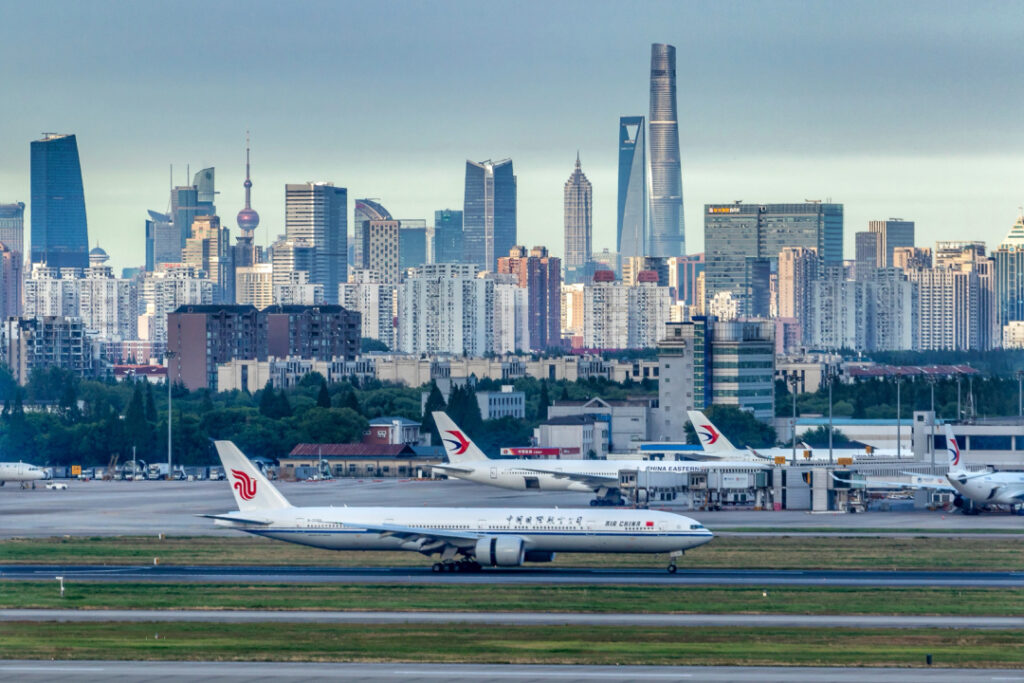
The Paradox: Record Traffic, Structural Strain. The Civil Aviation Administration of China (CAAC) released its October report card this week, and on the surface, the “Golden Age” seems to have returned.
- Total transport turnover: 14.6 billion ton-kilometers, up 10.8%.
- Passenger numbers: 67.83 million, up 5.8%.
- Cargo: A historic breakthrough, surpassing 900,000 tons for the first time (up 13.4% year-over-year).
- International Recovery: Both passenger and cargo traffic on international routes grew by over 20%, signaling that China is reconnecting with the world.
However, the Q3 financial reports from the sector’s reporting heavyweights reveal a structural crisis hidden behind these traffic jams. Data from the ‘Big Five’ serves as a grim signal for the wider industry: despite the surge in footfall, four of these major groups remain deeply unprofitable.
The Financial Reality Check: The Tip of the Iceberg. While our analysis focuses on the “Big Five” reporting entities due to their transparent Q3 disclosures, they are merely the financial weather vanes for a much larger ecosystem. China’s aviation infrastructure is anchored by over a dozen major provincial and regional airport groups, including heavyweights like Guangdong Airport Group (managing the massive Guangzhou hub), West Airport Group (controlling the Northwest), and Zhejiang Airport Group.
The earnings reports from the visible “Big Five” offer a brutal sample of the systemic reality facing the entire sector. The correlation between “more planes” and “more money” has broken down.
- Capital Airports Holdings: The operator of the nation’s primary gateway grew revenue slightly by 1.1% to 13.68 billion RMB, yet posted a net loss of 2.46 billion RMB (US$ 350 million).
- Sichuan Airport Group: Revenue stood at 5.11 billion RMB (+3.8%), but the group lost 1.18 billion RMB (US$ 170 million). The loss remained flat year-over-year, indicating that the recovery in Chengdu’s massive traffic has not translated into financial health.
- Chongqing Airport Group: The situation deteriorated significantly. Revenue dropped by 0.3%, while net losses widened by a staggering 664 million RMB to reach 1.24 billion RMB (US$ 180 million).
- Yunnan Airport Group: Despite a 14.4% tourism-driven revenue jump, the group still lost 278 million RMB (US$ 39 million).
- The Systemic Logic: Whether it is these reporting entities or the silent giants like West Airport Group, the structural logic remains the same. Massive volumes at hubs are struggling to offset the fixed-cost burden of their sprawling provincial networks.
- The Sole Survivor: Only Shanghai Airport Authority reported a healthy profit. Revenue hit 7.2 billion RMB, and net profit reached 1.43 billion RMB (US$ 200 million), up 13.08%.
Tianlux Insight: The Triumph of Asset Purity. Why is Shanghai the only winner in a sea of red? The answer is structural. Unlike its peers across the country, Shanghai Airport Authority (the listed entity) operates with “Asset Purity.” It manages only two assets—Pudong and Hongqiao—both distinct high-volume cash cows. Crucially, it is free from the political burden of cross-subsidizing a portfolio of money-losing regional feeder airports. While other groups act as “public utilities” responsible for province-wide connectivity, Shanghai operates as a pure-play commercial hub, effectively a luxury mall with a runway attached, unencumbered by dead weight.
The Airline Reality: The Yield Trap. Are airlines faring better? Yes, but with a major caveat. While the “Big Three” and private carriers like Spring Airlines reported profits in Q3 due to the traditional peak season, the margins tell a different story. We are witnessing a “Volume-Value Divergence.” The Mechanism: Carriers are trading Yield for Volume. To fill the record number of seats, especially with widebodies retired from international routes flooding the domestic market, carriers have engaged in a brutal price war. Average ticket prices are softening even as load factors rise. The Result: Airlines are working harder to make the same amount of money. They are “busy but poor.” This reinforces the “Profitless Boom” narrative. The industry is generating massive GDP activity, but retaining very little economic value.
Tianlux View. The recovery is here, but the business model is strained.
- For Airports: The “Provincial Group Strategy” has become a financial anchor. As consumption softens, volume alone cannot cover the fixed costs of a sprawling infrastructure network that includes dozens of unprofitable regional airports.
- For Airlines: The “Price War” is eroding the benefits of traffic growth.
- The Verdict: Investors should be wary of the headline traffic numbers. In 2026, the smart money will bet on Asset Purity (independent hubs like PVG) and Yield Discipline (carriers who refuse to join the race to the bottom), rather than chasing raw volume.
POLICY & REGULATION
THEME: THE ARCHITECTURE OF CONTROL
The “1.0” Era for Low-Altitude Control. The Central Air Traffic Control Committee Office has officially released the “1.0 Version” specifications for national and provincial low-altitude supervision platforms. Context: It is crucial to note the source. This Office serves the Central Air Traffic Control Committee, a body reorganized in 2021 to report directly to the CPC Central Committee, rather than the State Council or the Military alone. In the Chinese political hierarchy, this direct lineage to the Party’s core signifies absolute priority and ensures that no ministerial silos can block execution.
The Details:
- Three-Tier Architecture: The system mandates a strict hierarchy: National, Provincial, Municipal.
- Unified Standards: It forces unified interfaces for flight reporting, warnings, and data sharing.
- One Net Handling: It explicitly calls for “One Window Acceptance” for flight approvals, aiming to solve the bureaucratic nightmare of multi-department approvals.
Why it matters: This signals the end of the “wild west” phase for drones and eVTOLs. Until now, low-altitude economy was a concept driven by OEMs and local governments rushing to build disparate systems. Now, the central regulator is stepping in to build the “digital highway code.” Tianlux Analysis: By standardizing the data exchange format, Beijing is preparing the infrastructure for high-density autonomous traffic. It is a move to standardize the infrastructure so that hardware OEMs can eventually scale. However, it also means the barrier to entry for platform operators just got much higher; you either play by the Central Office’s data rules, or you don’t fly.
The “Strictest” Power Bank Rules: A Supply Chain Purge. Following a series of cabin fires, including a high-profile incident on a Scoot flight (TR939) from Hong Kong to Singapore this week where a passenger’s laptop battery ignited mid-flight, the Ministry of Industry and Information Technology (MIIT) is drafting mandatory safety standards for power banks.
The Policy: The new “Mobile Power Safety Technical Specifications” will be mandatory, not recommended.
- Smart Management: It requires power banks to have “smart management systems” that monitor battery health.
- Lifespan Labeling: Devices must carry explicit labels indicating “suggested safe service life.”
- The Timeline: The standard is expected to be implemented in June 2026.
The Industry Impact: This is a supply chain purge disguised as a safety rule. The new standards will force low-cost, “white label” battery manufacturers out of the market, as they lack the R&D capability to install smart management chips. For airlines, this provides a clearer enforcement standard at security checkpoints. For passengers, the era of cheap, disposable power banks is ending. We expect compliance costs to rise, but the reduction in in-flight thermal runaway incidents will be the payoff.
Consumption as Policy: Pivoting from Transport to Lifestyle. Six government departments, including the MIIT, the Ministry of Culture and Tourism, and the People’s Bank of China, jointly issued a directive to include “low-altitude tourism,” “aviation sports,” and “private flying” in the national consumption promotion list.
Translation: The government is desperate to find new consumption drivers. With traditional real estate and retail consumption slowing, the “experiential economy” is being targeted as the new growth engine. The Strategy: Expect local governments to subsidize “flight camps” and aerial tours as a way to boost local GDP figures. This creates a subsidy-driven boom in the short term, but the long-term viability depends on whether the Chinese middle class, currently tightening their belts, is willing to pay for “flying for fun.”
INDUSTRY & OEM
THEME: THE STATE TIGHTENS ITS GRIP
COMAC’s 44 Billion RMB (US$ 6.2 billion) War Chest. COMAC (Commercial Aircraft Corporation of China) has recently completed a massive capital registration change. Its registered capital has jumped from roughly 50.1 billion RMB (US$ 7.1 billion) to 94.1 billion RMB (US$ 13.3 billion), an increase of nearly 88%.
The Cap Table Shift: A Consolidation of State Power. The source of this money is as important as the amount. The shareholder structure has shifted significantly towards central control.
- The Leader: SASAC (the State-owned Assets Supervision and Administration Commission) led the injection with nearly 8 billion RMB (US$ 3.5 billion), increasing its controlling stake from 49.8% to 53.08%.
- The Supporters: Strategic industrial partners increased their stakes, including Aluminum Corporation of China (materials), China Electronics Technology Group (avionics), and China National Building Material Group (composites).
- The Diluted: Peripheral shareholders like China Reform Holdings, Sinochem, and even AVIC (Aviation Industry Corporation of China) saw their relative shareholding ratios decrease. Notably, Sinochem did not participate in this capital increase at all.
Tianlux View: The War Chest Strategy. This is not a commercial fundraising round; it is a strategic mobilization. As the C919 ramps up production and the widebody C929 enters critical R&D phases, Beijing is ensuring that its “National Champion” is flush with cash.
- Supply Chain Integration: The increased stakes from Aluminum Corp and China Electronics suggest a tighter integration of the upstream supply chain directly into COMAC’s equity structure.
- Financial Immunity: This 94 billion RMB war chest is designed to insulate COMAC from external shocks. It ensures that the company can continue to invest in supply chain localization (Indigenization) without relying on bank loans or fluctuating market sentiment.
A Symbolic Delivery: The 200th Jet. This week, Air China received its 7th C919 (Registration B-658R, MSN 00039). The aircraft was ferried from Shanghai to Beijing immediately upon delivery. More significantly, this delivery marks the 200th aircraft delivered by COMAC since its founding (27 C919s and 173 C909s).
History Check: It took COMAC roughly 10 years to deliver its first 200 jets (the first ARJ21 was delivered in late 2015). How does this compare? It mirrors the trajectory of Airbus in the 1970s, which took about 9 years to reach the 200 mark as it fought to break the US monopoly. In contrast, Embraer’s ERJ series sprinted to 200 jets in just under 4 years in the late 90s, powered by a mature Western supply chain.
Tianlux Insight: COMAC’s timeline reflects the immense difficulty of building a regulatory and industrial system from scratch rather than just assembling parts. But look at the acceleration: the first 100 aircraft took 7 years; the second 100 took only 3. We are at the inflection point. The “Science Project” phase is over. With 200 aircraft in the wild, the challenge shifts immediately from “can we build it” to “can we support it.” The operational data gathered from these 200 airframes will be critical for the C919’s EASA certification bid, proving reliability in diverse operating conditions.
The “Panda” Retreats: Sichuan Airlines Cuts the A350. In a surprising move for an all-Airbus loyalist, Sichuan Airlines is reportedly beginning to retire its flagship A350-900 fleet.
- The Status: Two aircraft (B-32HG, B-32MV) were never taken up and have already joined Ethiopian Airlines. Another active jet (Registration B-304U) flew from Chengdu to Guangzhou this week for a “lease return check.”
- The History: Sichuan Airlines was the launch customer for the A350 in China, famously painting them with “Panda” liveries to promote its brand globally. It had planned a fleet of 11.
Tianlux Analysis: This is a brutal yield management decision that mirrors the airport financial crisis we discussed in the Headline. The A350-900 is a technological marvel, but it is an expensive asset with a high cost per seat-mile if the front cabin isn’t full. The Takeaway: Sichuan Airlines, which reported a 1.18 billion RMB (US$ 167 million) loss in Q3, is likely finding that its long-haul international routes cannot support the premium capacity of the A350. Downsizing suggests a strategic contraction: prioritizing survival over prestige, shedding high-cost widebodies to focus on a leaner, more efficient fleet mix. It serves as a warning that secondary hubs in China may struggle to sustain long-haul international networks in the current economic climate.
Boeing’s Quiet Milestone. Greater Bay Airlines (GBA) in Hong Kong received China’s first Boeing 737 MAX 9 this week. The Delay: This aircraft arrives nearly two years late, delayed by the global scrutiny following the Alaska Airlines “door plug” scandal. The Detail: The aircraft features an extended fuselage capable of carrying 220 passengers, a key efficiency booster for GBA’s low-cost model. Why it matters: While COMAC dominates the headlines, Boeing is slowly normalizing its delivery stream. Its arrival in Hong Kong creates a regulatory precedent that may smooth the path for mainland carriers to eventually receive the MAX 9, provided geopolitical winds allow.
LOW-ALTITUDE ECONOMY & eVTOL
THEME: FROM POWERPOINT TO ORDER BOOK
The Zhuhai Signing Marathon. If the CAAC data shows a profitless boom in traditional aviation, the low-altitude sector is experiencing a paper boom of historic proportions. The Aero Asia 2025 show in Zhuhai became a marathon of signing ceremonies, but the details reveal who is actually paying.
- Lanyi Aviation: Secured orders for 130 aircraft (LE200/LEU100) from partners including Anfei and Hongjian.
- Aerofugia: Signed a definitive agreement for 50 AE200s with Sino Jet. This is significant because Sino Jet is a top-tier business aviation operator. It suggests a specific, high-value use case: “eVTOL + Business Jet” transfers for VVIPs, rather than mass transit.
- ZeroG: Debuted its tilt-rotor ZG-T6 and signed 50 orders with BOC Financial Leasing.
- Volant: Locked in supply chains with CALB (batteries) and SOTEA (motors), aiming for TC (Type Certificate) by 2026.
Tianlux Insight: The Financialization of eVTOL. The most critical detail here is not the number of planes, but the names of the buyers. The entry of BOC Financial Leasing (Bank of China) signals that institutional state money is finally comfortable enough with the asset class to start writing checks. The sector is maturing from “venture capital bets” to “asset leasing.” However, the sheer volume of orders—hundreds signed in a single day—raises questions about delivery timelines. The industry risks an “order bubble” where backlog far exceeds production capacity.
Exporting the Sandbox: EHang in Thailand. EHang completed a passenger-carrying demo flight in downtown Bangkok this week. Crucially, the passenger was Manat Chavanaprayoon, the Director of the Civil Aviation Authority of Thailand (CAAT). The Strategy: EHang is playing a game of “Regulatory Diplomacy.” By helping Thailand set up a “Sandbox” model for urban air mobility, Chinese OEMs are writing the rules for the Southeast Asian market before Western competitors even arrive. They are exporting the standard, not just the product. The goal is to make Thailand the launchpad for a region-wide ASEAN network by 2026.
Infrastructure Innovation: The Waterport. AutoFlight unveiled a “zero-carbon water airport” solution in Kunshan. The system allows eVTOLs to operate from floating platforms, demonstrated by a 2-ton eVTOL takeoff. The Logic: In land-scarce regions like the Greater Bay Area or the Yangtze River Delta, land acquisition is the single biggest cost barrier for vertiports. Moving the infrastructure to the water bypasses the zoning headaches and NIMBY (Not In My Back Yard) complaints of urban residents. It is a pragmatic, uniquely Chinese solution to the infrastructure bottleneck.
The Supply Chain Shift. Analysis from the Aero Asia show reveals a fundamental shift in the supply chain. 87.1% of exhibitors were Chinese enterprises. The most active sectors were not traditional general aviation, but UAVs (9.5%) and eVTOLs (4.2%). Tianlux View: The center of gravity for general aviation is shifting. The US model relies on “private ownership of fixed-wing planes”; the emerging China model relies on “commercial operation of electric vertical lift.” The supply chain is localizing rapidly, with Guangdong and Jiangsu provinces emerging as the new clusters for avionics and airframes, effectively creating a parallel ecosystem to the traditional Western GA supply chain.
ICYMI: SIGNALS IN THE NOISE
The Russia Pivot Deepens. Aeroflot is launching a new scheduled route between Khabarovsk and Shanghai Pudong starting December 24. The Context: This isn’t just a schedule change; it’s a policy dividend. On December 1, Russia enacted a visa-free entry policy for Chinese citizens (up to 30 days), reciprocating China’s earlier move. The Signal: With the visa barrier removed, the “pivot to Asia” shifts from state-level strategy to street-level reality. Shanghai is cementing its role as the critical economic lifeline for the Russian Far East. While intended for tourism, we expect this specific route to be dominated by business traffic, facilitating the cross-border energy and resource trade that now sustains the Russian economy.
China Eastern’s Northern Pivot. On November 27, China Eastern Airlines officially unveiled its Northeast Branch in Shenyang, creating its first cross-provincial regional hub. The Strategic Logic: This is a defensive move turned offensive. With its Shanghai base heavily squeezed by high-speed rail, China Eastern is executing a “Fly Far” strategy, expanding into the Northeast to capture long-haul routes (like Shenyang-Moscow) that trains cannot touch. The Vacuum: The Northeast has been an aviation orphan since China Northern Airlines was absorbed by China Southern in 2002. With regional traffic growth lagging at just 1.9% (the slowest nationally) and local startups failing repeatedly, China Eastern is betting that a consolidated “state-owned outsider” can succeed where fragmented local players have struggled.
Sinopec’s European Reach. UNIPEC (Sinopec’s trading arm) has signed a long-term supply deal with Lufthansa, committing 60,000 tons of aviation fuel annually to airports in Germany and Belgium. The Insight: While Brussels scrutinizes Chinese EVs, Chinese SOEs are quietly embedding themselves into Europe’s critical aviation infrastructure. With UNIPEC already supplying 120,000 tons of Sustainable Aviation Fuel (SAF) in Europe this year, China is positioning itself not just as a fuel vendor, but as an indispensable partner for Western carriers desperate to meet their decarbonization mandates.
AirAsia Cuts China Capacity. According to the latest schedule filings, Thai AirAsia is suspending routes from Bangkok (Don Mueang) to Guangzhou, Shenzhen, and Xi’an, effective from March 2026. The Reality Check: This contradicts the “visa-free travel boom” narrative. While policy barriers have fallen, the economic reality is biting. The yield on China-Thailand routes is under immense pressure due to weak demand and lower per-capita spending by tourists. LCCs are ruthless with capital efficiency; they are redeploying jets to higher-yield markets like India. It is a warning that policy incentives cannot override macroeconomic weakness.
Contact us with tips, pitches and feedback.

Our Service
We bridge insight, expertise, and trusted networks to help our clients navigate China’s evolving aviation landscape.

We help Chinese aviation enterprises and investors manage international exposure, partnerships, and certification risks through tailored consulting and market insight.

We compile and interpret aviation developments between China and the world, turning fragmented information into structured, fact-based analysis for decision-makers.

We provide discreet, insight-driven advisory based on trusted relationships and a deep understanding of global aviation stakeholders.